- The Short Answer: How to Choose the Best AC Repair Company
- 1. Verify the License and Insurance First
- 2. Read Reviews the Right Way
- 3. Get Written, Itemized Estimates — at Least Two
- 4. Ask About the Warranty on Parts AND Labor
- 5. Choose a Company That Knows Marco Island
- 6. Confirm They Are Full-Service, Not One-Trick
- 7. Red Flags That Mean "Keep Looking"
- 8. Five Questions to Ask Before You Hire
- The Bottom Line
The Short Answer: How to Choose the Best AC Repair Company
The best AC repair company for your Marco Island home is licensed and insured in Florida, has strong recent reviews from local homeowners, gives you a written itemized estimate before work starts, backs repairs with a parts-and-labor warranty, and understands coastal-Florida systems — salt-air corrosion, high humidity, and year-round cooling loads. Verify all five before you book.
1. Verify the License and Insurance First
This is the non-negotiable step. In Florida, air conditioning contractors must hold a state or local license — Class A (unlimited) or Class B (residential/small commercial). Ask for the license number up front and check it on myfloridalicense.com, the state's official portal. It takes two minutes.
Why it matters so much on Marco Island:
- Liability protection. If an uninsured technician is injured on your property, or damages your home, you can be on the hook.
- Code compliance. Licensed contractors pull permits where required and follow Florida building codes — unpermitted work can bite you at resale.
- Training. Licensing requires documented experience and passing trade exams, so you are not getting someone learning on your system.
Also ask about certifications. Technicians certified by NATE (North American Technician Excellence) have passed industry-standard tests on installation and service, and many manufacturers factory-train technicians on their equipment. It is a meaningful quality signal, not just a logo.
2. Read Reviews the Right Way
Google reviews, Yelp, and the Better Business Bureau are your first screen — but read them like a detective, not a scorekeeper. A 5.0 rating from eleven reviews says less than a 4.7 from four hundred.
What to look for in reviews of any AC repair company:
- Recency and volume. Dozens of reviews from the last year carry more weight than a handful from 2021.
- Consistency across platforms. Strong ratings on Google and Yelp and the BBB are harder to fake than one glowing page.
- Specifics about the work. "Diagnosed a bad capacitor, explained the options, done in an hour" tells you more than "great service."
- How they respond to complaints. A professional reply to a negative review — no defensiveness, an offer to make it right — is a genuinely good sign.
- Local names and neighborhoods. Reviews from Marco Island, Cape Marco, Hideaway Beach, and Olde Marco tell you the company actually works where you live.
3. Get Written, Itemized Estimates — at Least Two
Never hire a company that will not put its quote in writing before work begins. A proper estimate names the specific equipment and parts, separates parts from labor, states the efficiency rating where relevant, spells out warranty terms, and discloses the diagnostic fee and any after-hours charges.
For ballparks: one HVAC pricing guide puts diagnostic/service calls at roughly $80 to $150, tune-ups at $90 to $200, and common repairs (capacitor, contactor, refrigerant leak) from a few hundred to over $1,000 depending on the part. Consumer research from Bay Area Consumers' Checkbook found quotes for the same dual-run capacitor replacement ranging from $150 to $478 — which is exactly why you compare. Their rule of thumb: if the estimate exceeds about $500, get additional quotes.
Marco Island-specific note: prices here can run higher than inland Florida because corrosion-resistant work, attic air handlers in seasonal homes, and emergency response during heat waves all cost more. That is fine — what you are screening for is transparency, not the lowest number. Dramatically low quotes usually mean cut corners on parts, permits, or the diagnosis itself.
4. Ask About the Warranty on Parts AND Labor
This one separates professionals from fly-by-night operators. A reputable company puts its warranty in writing and covers both parts and labor — typically at least one year on most repairs. Here is the distinction that matters:
- Manufacturer warranty covers the replacement part itself, but often not the labor to install it twice if the repair fails.
- Labor warranty is the company's own promise: if their work fails within the warranty window, they come back and fix it without charging you again.
If a company only talks about the manufacturer's parts warranty and goes vague on labor coverage, keep looking. And get the terms in writing on the invoice — a verbal "yeah, we'll take care of it" is worth nothing when something goes wrong in September.
5. Choose a Company That Knows Marco Island
National call centers and out-of-area outfits do not know what your system is up against here. Marco Island's climate is brutal on air conditioning equipment in specific, predictable ways:

- Salt-air corrosion eats condenser coils and electrical connections — outdoor units near the water age faster than the same unit inland.
- High humidity means condensate drains clog constantly; a tech who has never dealt with Southwest Florida algae growth in a drain line will misdiagnose the symptoms.
- Seasonal homes sit empty for months with the AC at 78°F, then get slammed to 72°F when owners return — technicians here need to check for mold in drain pans and air handlers on startup.
- Year-round cooling loads wear components faster than systems in cooler states; a company used to six-month seasons will under-service your equipment.
A local company also stocks the right parts, knows Collier County permit norms, and can actually get to you quickly when the AC dies at 8 PM on a Friday. Ask how long they have served Marco Island specifically — not just "Southwest Florida" — and whether they handle the brands common here. For bigger decisions, see our guide on AC repair vs. replacement.
6. Confirm They Are Full-Service, Not One-Trick
The best contractor is the one you can call for anything, not just a single repair. Before hiring, check that the company handles:
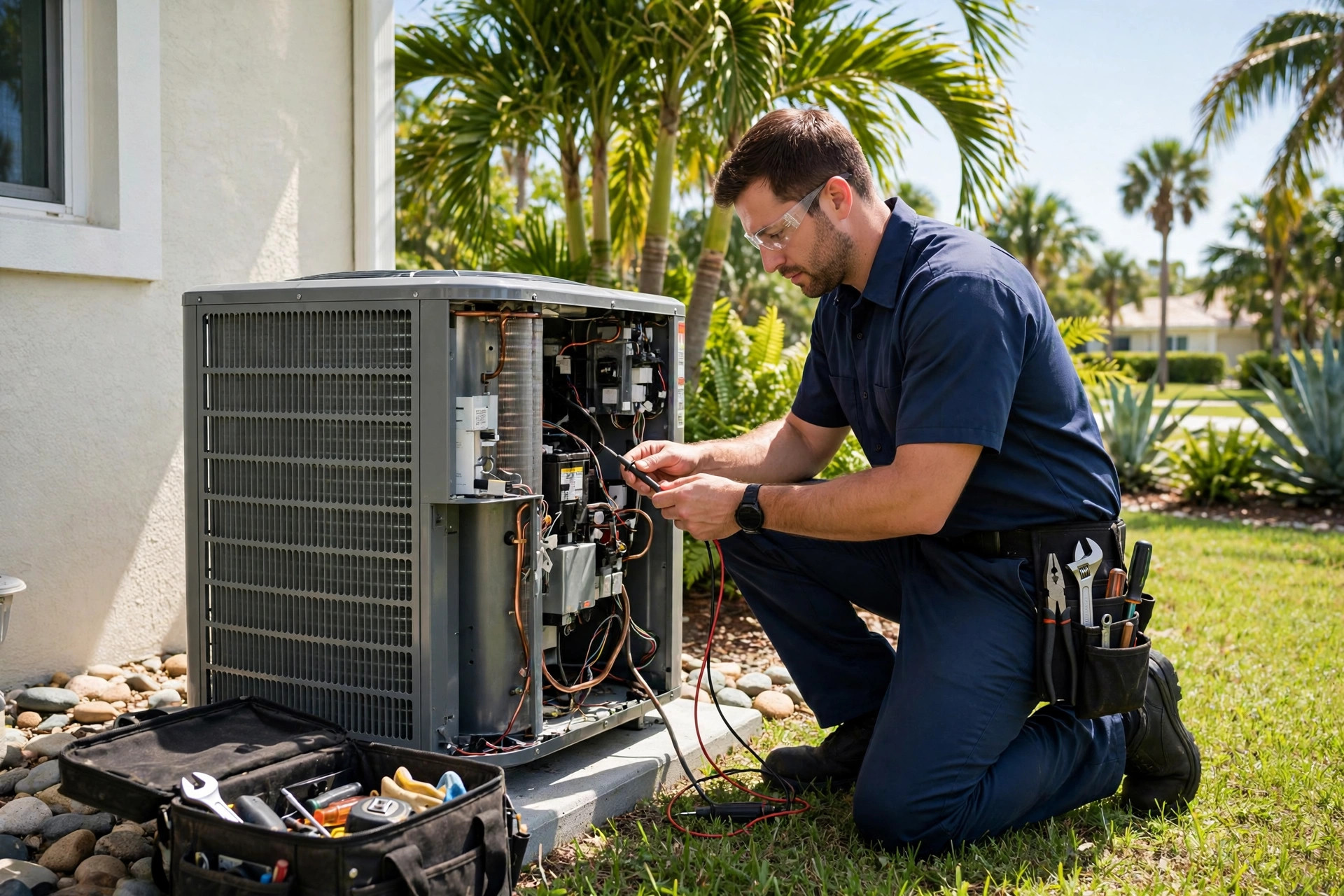
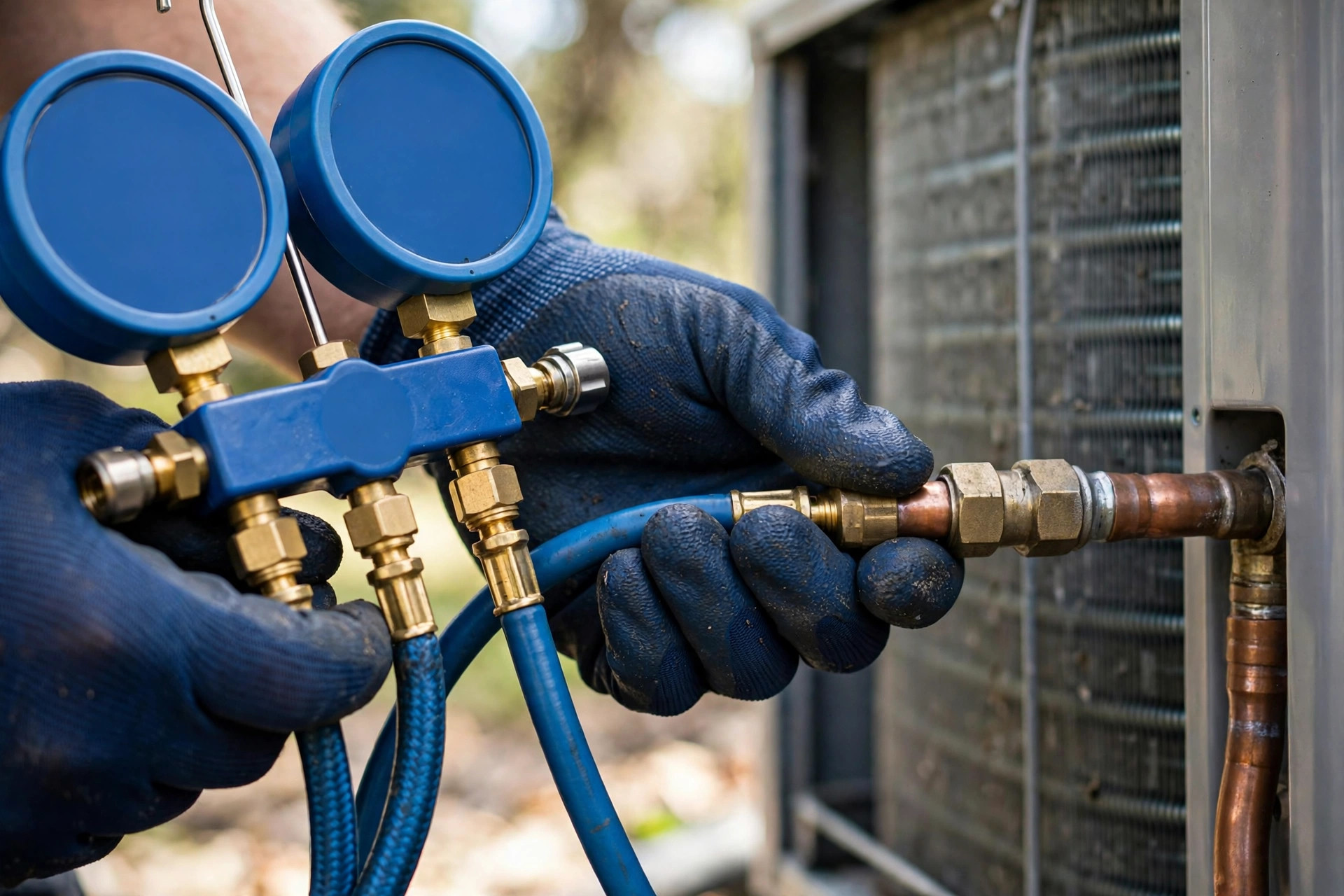
- Real diagnostics — measuring refrigerant pressures, testing capacitors and contactors, inspecting evaporator and condenser coils — not just topping off refrigerant and leaving.
- Installation with a proper Manual J load calculation, so a replacement is sized correctly for your home rather than guessed.
- Preventive maintenance plans, because routine tune-ups are what keep coastal systems alive and protect manufacturer warranties.
- Emergency service with genuine 24/7 dispatch — in Florida's heat, "we'll come Monday" is not always an acceptable answer.
- Ductwork and ductless systems, since airflow problems are often the root cause behind "my AC runs but never cools."
A company that can only do one thing will try to sell you that one thing, whether it is the right fix or not.
7. Red Flags That Mean "Keep Looking"
Some warning signs should stop the process cold:
- No license number, or hesitation when you ask. Legitimate companies put it on their truck, their website, and their quotes.
- No written estimate. Verbal pricing becomes a much bigger number on the invoice.
- The diagnostic fee is not disclosed before the visit. Reputable companies state it on the phone.
- Pushing full replacement without showing you the failing part. A good tech shows you the corroded coil, the bulging capacitor, the leaked refrigerant — and explains your repair-vs-replace options honestly.
- High-pressure tactics. "This price is only good today" is a sales trick, not a diagnosis.
- They only do cash, or demand full payment upfront. Standard practice is a deposit for large jobs, balance on completion.
- No physical local presence. A P.O. box and a cell number are not a Marco Island business.
8. Five Questions to Ask Before You Hire
Use this script on the phone. A good company answers all five without hesitating:
- "What is your Florida license number?" — Then verify it online.
- "What is your diagnostic fee, and does it apply toward the repair?" — Know the cost before the truck rolls.
- "Will I get a written, itemized estimate before you start work?" — The answer must be yes.
- "What is your warranty on parts and labor?" — At least a year, in writing, on both.
- "Can you show me the failed part and explain my options?" — You deserve to see what you are paying for.
The Bottom Line
Choosing the best AC repair company on Marco Island is not about finding the cheapest quote or the biggest ad — it is about finding the licensed, insured, locally experienced team that diagnoses honestly, prices transparently, and stands behind its work in writing. Run any company through the checklist above and the right choice usually makes itself obvious.
If your AC is acting up now — blowing warm air, short-cycling, tripping breakers, or just not keeping up — call us at (239) 880-1889. We diagnose the real cause, explain your options clearly, and back our work with a written warranty. Marco Island homes get enough punishment from salt air and humidity; your repair company should not be another source of stress.