- The Short Answer: Help Exists, But There Is No Single Free-Repair Program
- Start Here: Dial 2-1-1 and Your Local Agency
- LIHEAP: Bill Help First, Equipment Help Sometimes
- Weatherization Assistance: The Program Most Likely to Replace a System
- Collier County Programs: Start With the County Itself
- Nonprofits and Charity Programs That Replace HVAC Systems
- Utility Programs, Rebates, and Low-Cost Paths
- What to Prepare Before You Apply
- If You Are Denied, or While You Wait
The Short Answer: Help Exists, But There Is No Single Free-Repair Program
If your air conditioner has failed and money is tight, the first thing to understand is that there is no single nationwide "free AC repair" grant that covers everyone. Instead, help comes from several different programs, each with its own rules: federal energy assistance, Florida's weatherization program, Collier County's own assistance programs, utility programs, and nonprofit home-repair charities. Some pay for a repair, some pay for a full replacement, some only help with the electric bill, and some do all three — but only for households that qualify, and usually only after an application, an inspection, or both.
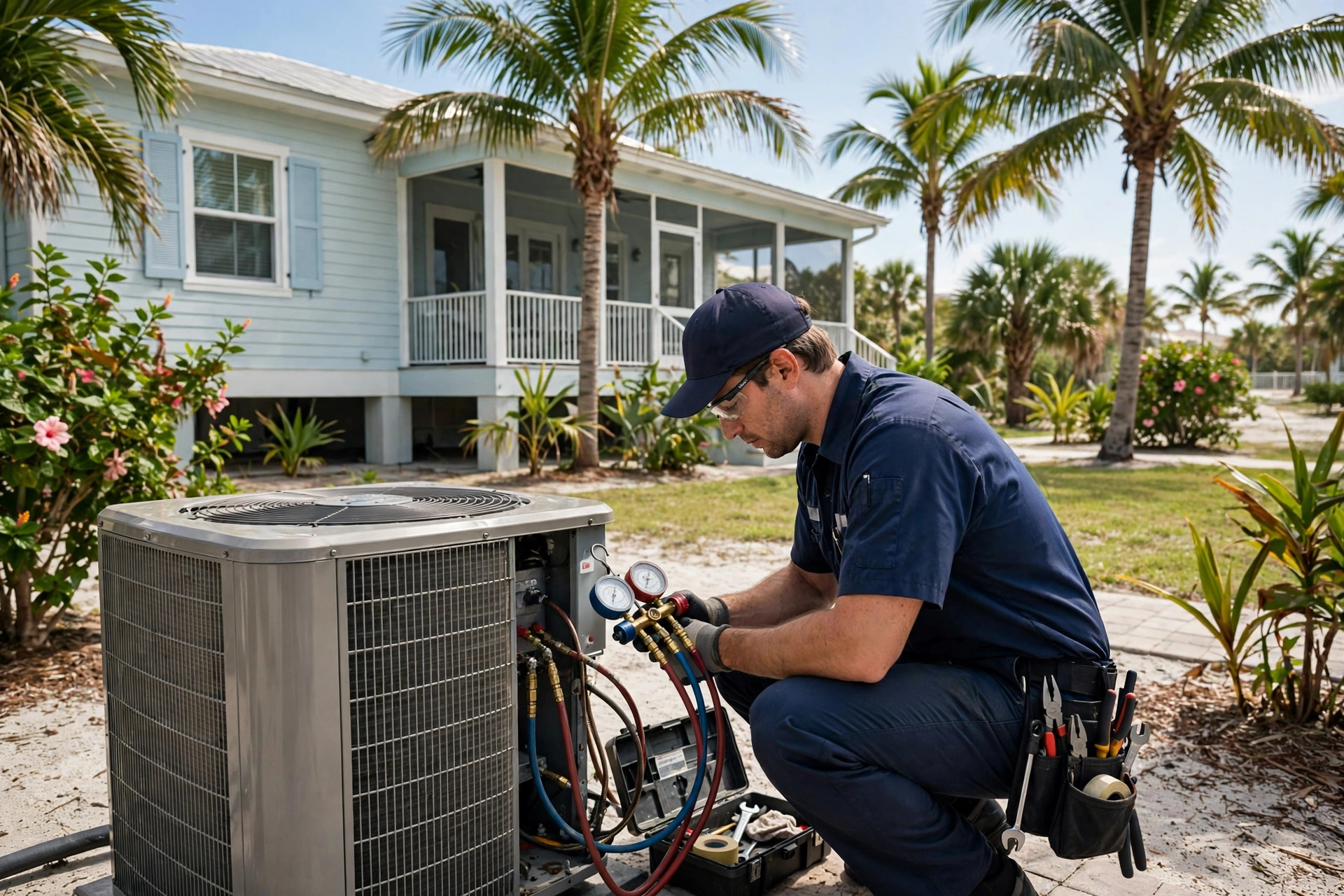
That matters in Marco Island more than in most places. A failed AC here is not just a comfort problem: heat and humidity build fast, a system left off for days can invite mold, and elderly residents, young children, and people with medical conditions face real risk. Salt air also corrodes outdoor coils, capacitors, contactors, and electrical connections faster than inland, so a system that limps along elsewhere may fail outright here.
Start Here: Dial 2-1-1 and Your Local Agency
If you only do one thing today, dial 2-1-1. It is the nationwide community-resource referral service, and the operator can match your ZIP code and household situation to the LIHEAP office, weatherization provider, senior services, and nonprofit repair programs actually operating in Collier County right now. Funding, waiting lists, and application windows change during the year, so a local referral beats any national list for current details.
Your second call should be to the local agency itself: the community action agency or county office that administers energy assistance for your address. Ask three specific questions: which programs cover AC repair or replacement (not just bill payment), what the current income limit is, and whether there is a waiting list or an emergency track. If one program says no, ask which other program they would refer you to — agencies refer to each other constantly, and a referral from one office often moves faster than a cold application to another.
LIHEAP: Bill Help First, Equipment Help Sometimes
The Low Income Home Energy Assistance Program, known as LIHEAP, is the federal program most people hear about first. It is funded federally and run locally, so exact benefits differ by state and county. Its main job is helping low-income households with energy bills, including cooling bills in summer, and it also has a crisis component for emergencies such as a shutoff notice or a failed cooling system during extreme heat.
Whether LIHEAP itself pays to repair or replace an air conditioner depends on where you live and how your local agency uses its funds. In some places, crisis funds cover a repair or replacement when a broken system poses a health or safety threat; in others, LIHEAP mainly pays bills and refers equipment work to weatherization. Ask your local LIHEAP office directly whether equipment repair or replacement is offered in Collier County. Priority commonly goes to households with elderly members, people with disabilities, families with young children, and households facing high energy burdens. The national LIHEAP information line is 1-866-674-6327, but the application itself goes through the local office serving your address.
Weatherization Assistance: The Program Most Likely to Replace a System
For a failed or badly inefficient air conditioner, the Weatherization Assistance Program (WAP) is often the most relevant federal program. Run in Florida through FloridaCommerce with federal Department of Energy funding and delivered by local agencies, WAP provides free home energy improvements to income-eligible households after a home energy audit. Its income limit is generally set at 200 percent of the federal poverty level, which is more generous than some bill-assistance cutoffs, so a household denied elsewhere may still qualify here.
Florida's WAP guidance lists HVAC system repairs, improvements, or replacement when justified by the audit among its allowable services, alongside air sealing, insulation, duct sealing and repair, attic ventilation, and solar screens. That "when justified" phrase is important: WAP does not simply hand out a new air conditioner on request. An auditor inspects the home, checks the evaporator and condenser coils, refrigerant charge, ductwork, airflow, and the system's age and condition, and then prepares a scope of work. If the audit justifies it, the work is done at no cost to the eligible household, using approved contractors — you do not hire your own contractor first and claim the money back.
Preference commonly goes to people aged 60 and older, people with disabilities, families with children, and households with high energy use. Florida's WAP page notes that low-income families pay an average of about 18 percent of annual income for energy, compared with about 5 percent for other households. Apply through your local weatherization office rather than online, and expect a wait: funding is limited and even eligible households are not guaranteed immediate service.
Collier County Programs: Start With the County Itself
Because Marco Island sits in Collier County, the county's own programs deserve a direct look — they are the ones most likely to cover an AC repair for a Marco Island homeowner.
The county's Community Assistance program, run through Collier County Community and Human Services, describes help that can include air conditioner repair or replacement, with county guidance putting the maximum benefit at $5,000 total per year for past-due electric bills and/or AC work, and noting that AC assistance is for homeowners. County guidance also describes following 150 percent of federal poverty guidelines, with different treatment for households where a member receives Social Security, SNAP, or TANF benefits and a household member is 60 or older — so do not self-screen out on income alone; call Community and Human Services at (239) 450-2114 and ask how your household is counted. For a new HVAC system, county guidance says applicants may be asked for multiple air conditioning estimates and, if the system costs more than the benefit, documentation showing how the rest will be paid in full.
Separately, the county's Emergency Home Energy Assistance Program (EHEAP) is described as available to households with a delinquent electric bill where an adult aged 60 or older lives in the home, and it can also assist with repair or replacement of air conditioning for an elderly homeowner household. If you are 60 or older and your bill is past due, mention both the bill and the broken AC in the same call.
The county also runs an owner-occupied rehabilitation program, with interest-free deferred loans of up to $50,000 described for eligible homeowners in unincorporated Collier County, Naples, Marco Island, or Everglades City. That is a loan, not a grant — but for a homeowner facing a full system replacement plus other needed repairs, it is worth asking about. Confirm current rules before relying on these figures, as benefit amounts and funding change.
Nonprofits and Charity Programs That Replace HVAC Systems
Beyond government programs, several nonprofits repair or replace heating and cooling systems at no cost to qualifying homeowners — but they are selective, local, and often nomination-based, so they work best as a parallel track, not your only plan.
Rebuilding Together affiliates are one of the strongest examples: the nonprofit states that it provides repairs at no cost to qualifying homeowners, and its eligible work specifically includes heating and air conditioning repair and replacement in the affiliates that offer it. Eligibility commonly involves owning and occupying the home, meeting local income limits, and often being an older adult, a veteran, or a person with a disability — but each affiliate sets its own rules, so ask the nearest affiliate what it covers in Southwest Florida.
Habitat for Humanity affiliates are another route: some run home-repair or weatherization services that can include HVAC work, while others focus on other repairs, so the local affiliate is the authority. Lennox's Feel The Love program donates and professionally installs complete heating and cooling systems at no cost for selected homeowners facing financial or other significant hardship, chosen through nominations rather than a standard application.
Utility Programs, Rebates, and Low-Cost Paths
Your electric utility is another door worth knocking on. Utilities in Florida run low-income weatherization and efficiency programs — for example, Florida Power & Light's published low-income weatherization standards describe free installed energy-saving measures for qualifying customers through approved agencies. Call your utility and ask about low-income weatherization, hardship assistance, and rebates for a qualifying efficient replacement system.
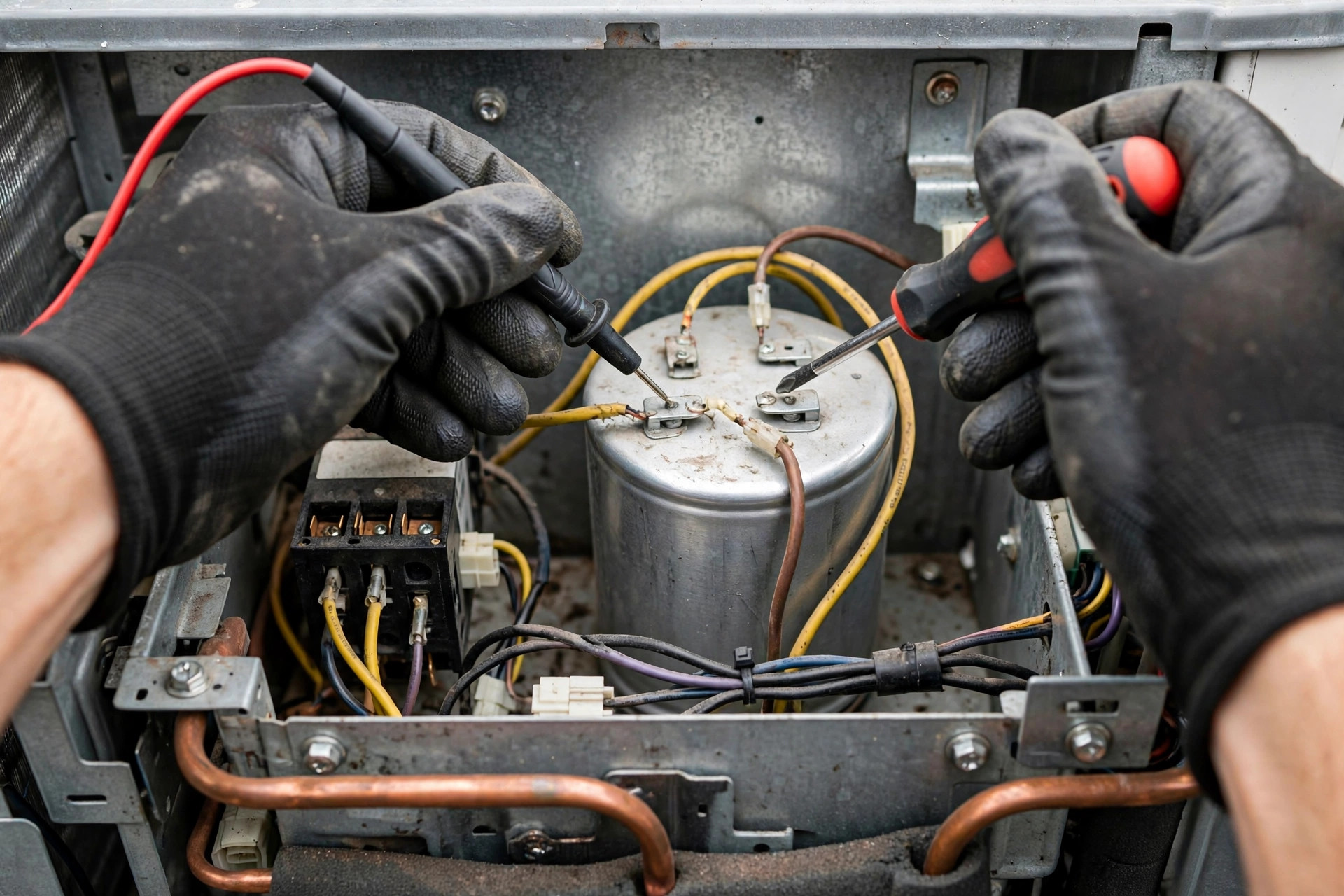
If no grant covers the work, the low-cost path is still worth planning carefully. Get a proper diagnosis first: a failed capacitor, contactor, thermostat, or condensate drain problem can cost far less than a replacement, and a technician who checks the whole system — coils, refrigerant, airflow, ductwork, and electrical components — can tell you whether a targeted HVAC repair is sensible or whether salt air has already finished the system. For a replacement, get every quote in writing with the equipment model, SEER2 rating, and warranty spelled out, and ask about manufacturer and utility rebates. Once the system is fixed, AC maintenance — clean filters, washed coils, a clear condensate drain — is the cheapest way to avoid the next emergency.
What to Prepare Before You Apply
Programs move faster for applicants whose paperwork is already in order, and incomplete files are one of the most common reasons requests stall. Put together a folder — paper and digital — with proof of identity for all adults, Social Security cards for household members, proof of income for everyone in the household (pay stubs, Social Security or pension statements, SNAP or TANF award letters), a recent electric bill, proof of homeownership or your lease plus landlord contact details, and any medical documentation if heat affects a health condition.
Add the HVAC evidence too: the system's age and model if you know it, photos of the unit, the technician's written diagnosis, and itemized repair or replacement estimates. If a program asks for multiple estimates — as Collier County guidance describes for HVAC work — having two or three comparable, written estimates ready saves weeks.
One warning applies to every program in this guide: never pay a contractor first and assume a grant will reimburse you. Most grant and weatherization programs require pre-approval, an inspection, or the use of an approved contractor, and work done before approval may not be covered. If someone demands an upfront fee to "unlock" a free AC program, walk away — legitimate programs do not work that way.
If You Are Denied, or While You Wait
A denial is not the end of the road. Ask for the denial reason in writing and check whether a different program uses a different income limit — a household over one program's limit may be under another's, especially since weatherization's 200-percent-of-poverty limit is more generous than some others. Keep applying in parallel: a LIHEAP crisis request, a weatherization intake, a county application, and a nonprofit inquiry can all be open at the same time, and one may cover the emergency while another funds the permanent fix.
While you wait, protect the home and the people in it. If the AC is out during extreme heat, use community cooling resources, stay with family or friends if possible, and treat heat illness symptoms as urgent. Keep the system off if a technician has flagged an electrical or refrigerant safety problem. If your system is still running but struggling, a maintenance visit to clean the coils, clear the drain, and check the capacitor and contactor can buy time — and if the diagnosis points to replacement, our AC replacement and AC installation pages explain how sizing, SEER2, and coastal protection should be judged.
Free AC repair help in Florida is real, but it rewards the households that apply early, apply to several programs at once, and arrive with their paperwork in order. Start with 2-1-1, call your local LIHEAP and weatherization offices, ask Collier County directly about its homeowner assistance, and keep a written diagnosis and itemized estimate ready for every application. If you need that diagnosis, call Marco Island AC Services at (239) 880-1889 — a clear answer about what is actually wrong is the first step, whichever program ends up paying for the fix.