- Is an AC Repair Estimate Really Free?
- How a Repair Visit Actually Works, Step by Step
- Free Estimate vs. Diagnostic Fee: The Real Difference
- Flat-Rate vs. Hourly: How Repair Pricing Is Structured
- What Every Written AC Quote Must Itemize
- Phone and Virtual Estimates: When They Help
- Red Flags in Repair Quotes and "Free" Offers
- Marco Island Reality: Salt Air, Seasonal Homes, and Quote Traps
- How to Get Three Comparable Quotes (the Smart Way)
- The Bottom Line
Is an AC Repair Estimate Really Free?
Short answer: not exactly — at least not the way most homeowners expect. In the HVAC industry, free estimates are standard for new installations and full system replacements, because those are large, planned projects. But when your existing system breaks down, what you're asking for isn't really an estimate — it's a technical diagnosis. Sending a trained technician with specialized tools to troubleshoot a compressor, capacitor, contactor, or control board costs the company money, so most companies charge a diagnostic or service fee for that visit.
Once the technician finds the problem, the actual repair quote — the price for parts and labor — is written down and given to you before any work starts. That's the part that's free to review. You can approve it, or decline it and pay only the diagnostic fee. Understanding this distinction saves you from surprise charges and from bait-and-switch ads that promise a "free estimate" but deliver a high-pressure sales visit.
How a Repair Visit Actually Works, Step by Step
1. The call and scheduling
When you call about a broken AC, the dispatcher should tell you the diagnostic or trip fee up front — typically $95 to $250 depending on region and company, per industry guidance from engineerfix.com. Ask whether the fee is credited toward the repair if you proceed; many companies waive it when you approve the quote.
2. The diagnostic visit
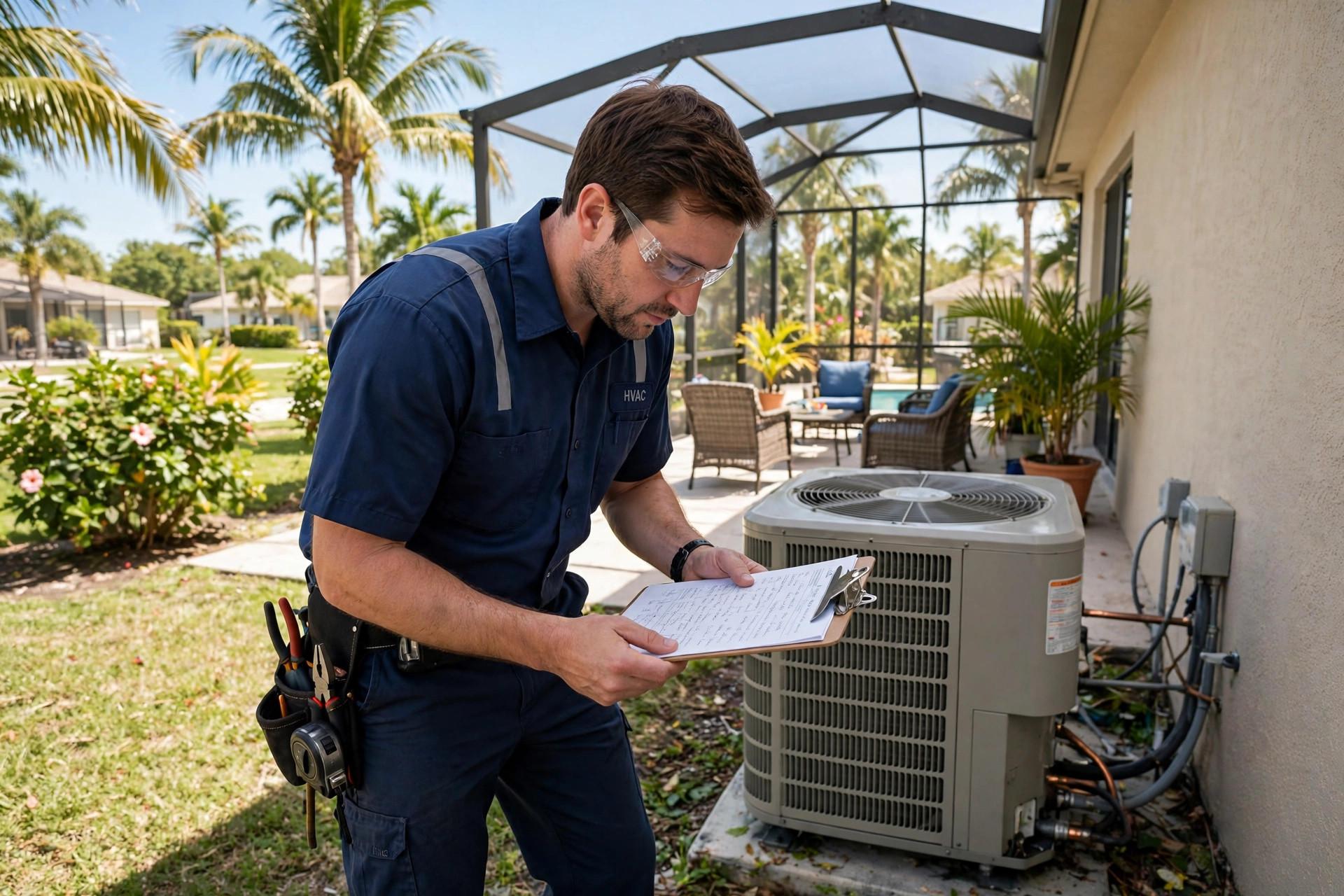
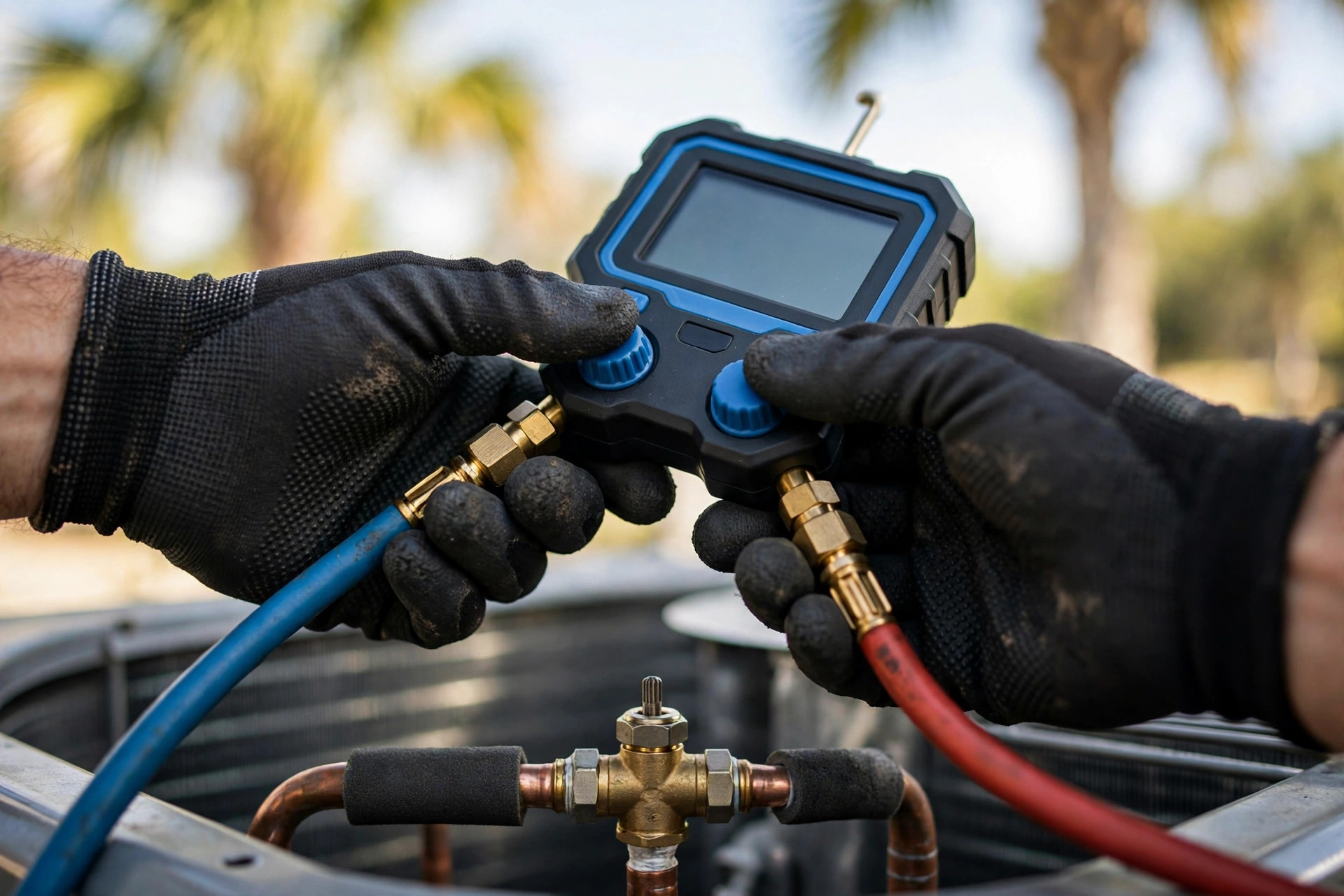
The technician systematically tests your system: refrigerant pressures with manifold gauges, electrical readings, the capacitor and contactor, airflow, the condensate drain line, and the thermostat. This is skilled labor — the tech is narrowing down which component failed, not just guessing. In Marco Island's coastal environment, salt-air corrosion on the condenser coil and electrical components is a common culprit, and an experienced tech knows to check those points first.
3. The written repair quote
After diagnosis, you get a written quote. Common residential repairs and their typical price ranges (per cleartheairac.com, current as of September 2026) look like this: run capacitor $180–$320, contactor $190–$280, condensate drain clear $150–$250, refrigerant leak search and recharge $350–$650. A failed compressor is the big one at $1,800–$3,500. Most of these are same-visit repairs because trucks carry the common parts.
4. Your decision
Approve the quote and the work starts — often the diagnostic fee is then waived or credited. Decline it and you pay only the diagnostic fee, no obligation. A reputable company won't pressure you either way.
Free Estimate vs. Diagnostic Fee: The Real Difference
This is where most confusion — and most shady advertising — lives:
- Free estimate (typical): A new or replacement system quote. The company walks your home, runs a Manual J load calculation, discusses equipment options, and hands you a proposal. No failure to diagnose, so no fee. This is exactly what free estimate consultations for installation and system replacement look like.
- Diagnostic visit (typical for repairs): Your current system is broken. The company sends a technician to find out why. That trip costs money, hence the fee — but the resulting repair quote is free to review and decline.
Some companies advertise "free estimates" on repairs and then roll the diagnostic cost into an inflated repair price, or they use the free visit as a pretext to push an expensive replacement. A company that's upfront about a $99 diagnostic fee is often more honest than one advertising a free visit with hidden strings attached.
Flat-Rate vs. Hourly: How Repair Pricing Is Structured
Most residential HVAC companies quote flat-rate labor, and that usually works in your favor:
- Flat rate means one price for the whole job, agreed before work starts. You're not paying more if the job runs long, and the tech isn't incentivized to stretch the clock.
- Time and materials means you pay for hours worked plus parts as they add up. This can be fair for unusual or complex jobs, but it should always come with an honest estimate and a ceiling so the meter can't run away from you.
Also know the document types, from trade-business guidance at fieldpromax.com: an estimate is a best-guess price subject to discoveries; a quote is firmer, generally valid for a set period; a fixed-price proposal is binding regardless of what's found. Whatever you receive, it should name the document type and list the assumptions that could change the price.
What Every Written AC Quote Must Itemize
Use this checklist. If a quote is missing several of these, get a second opinion:
- Business identity — real business name, license number, and a way to reach a person (not just a cell number).
- The diagnostic or service fee — disclosed before the visit, with a clear statement of whether it's credited toward the repair.
- The failed part, by name — not "electrical work" but "dual run capacitor, 45/5 µF." Ask whether it's an OEM (manufacturer) or aftermarket part and what warranty the part itself carries.
- Labor — flat-rate or hourly, with the total shown. The same repair shouldn't cost wildly different amounts depending on the day.
- Refrigerant and consumables — if the quote includes a recharge, the refrigerant type and amount should be listed.
- Assumptions and exclusions — what could change the price (e.g., "if the evaporator coil is also leaking, additional $X").
- Validity period — how long the price is honored.
Phone and Virtual Estimates: When They Help
Not every problem needs a truck roll. Some Florida HVAC companies offer free virtual estimates — a 10–15 minute phone or video call where you describe symptoms, share photos of your equipment labels, and walk through basics like tripped breakers, thermostat resets after power surges, dirty filters, clogged condensate drains, and tripped float switches. Industry data from the Tampa Bay market suggests 40–50% of AC emergency calls involve issues in this category.

It's a useful first step, but be realistic: a phone call can't test a capacitor or read refrigerant pressures. If the issue can't be resolved remotely, the company schedules an in-person visit — and that visit carries the normal diagnostic fee.
Red Flags in Repair Quotes and "Free" Offers
- "Free estimate" with no fee disclosed at all — the diagnostic cost is often buried in the repair price or recovered through upselling.
- Vague line items like "electrical repairs — $900" with no part named.
- Pressure to replace immediately without a documented diagnosis of what's wrong. A failed capacitor doesn't mean you need a new system.
- No license or business name on the paperwork.
- After-hours surcharges not disclosed before the visit. If you need emergency AC repair in July, ask about any emergency rate up front.
- "The diagnostic is free, but..." — if the visit is free, ask directly what they earn from it. Often it's an upsell appointment.
Marco Island Reality: Salt Air, Seasonal Homes, and Quote Traps
Marco Island's coastal climate changes the math. Salt air corrodes condenser coils and electrical components faster than inland systems, which means two things for estimates: first, a thorough diagnostic should include a visual check for corrosion on the coil, contactor, and wiring — surface-level "it needs a new system" judgments without testing deserve skepticism. Second, if your home sits vacant part of the year, ask how the quote handles a system that's been idle for months; a seasonal maintenance visit after a long vacancy can catch small failures before they become quote-sized ones.
And keep in mind: Marco Island AC Services offers free estimates for installation and replacement consultations — the right fit when you're planning a system upgrade. For repairs on your existing system, expect the standard diagnostic-then-written-quote process used across the industry, with no obligation once you see the price.
How to Get Three Comparable Quotes (the Smart Way)
- Call three licensed companies and ask each two questions: "What's your diagnostic fee, and is it credited if I approve the repair?"
- Keep the symptom description identical for each call so quotes are comparable.
- Don't authorize work by phone — authorize only the diagnostic visit, and insist on a written quote on-site.
- Compare the named parts, not just totals. A $450 quote naming a contactor and a $300 quote naming the same contactor tell you something; a $450 quote that names nothing tells you something else.
- Check parts warranties — a cheaper aftermarket part with no warranty can cost more over the system's life.
The goal isn't the cheapest quote. It's the clearest one.
The Bottom Line
A "free AC repair estimate" is really two things: a paid diagnostic visit that pinpoints the failure, and a free, written repair quote you can accept or decline with no obligation. Expect a diagnostic fee in the $95–$250 range (often credited toward the repair), flat-rate pricing agreed before work starts, and a quote that names every part, the labor model, and the company's credentials.
If your Marco Island home is cooling fine but aging, or you're weighing repair versus a full replacement, the free consultation route applies. If the system just quit, call Marco Island AC Services at (239) 880-1889 — ask about the diagnostic fee and current offers, and you'll get the written quote before any work begins. That's how an honest estimate works.