- Can You Really Repair Your AC at Home?
- Fix 1: Check the Thermostat and Batteries
- Fix 2: Replace or Clean the Air Filter
- Fix 3: Reset the Breaker — Once
- Fix 4: Clear and Clean the Outdoor Condenser
- Fix 5: Clear the Condensate Drain Line
- Fix 6: Thaw a Frozen Evaporator Coil
- Fix 7: Open Vents and Check the Indoor Switch
- What Not to Touch — Call a Pro for These
- Marco Island Tips: Salt Air, Humidity, and Seasonal Homes
- When DIY Ends and the Technician Begins
Can You Really Repair Your AC at Home?
Yes — more of it than most homeowners realize, but less than the internet sometimes suggests. A surprising share of "my AC stopped cooling" service calls come down to a handful of simple problems you can safely fix yourself in under 30 minutes: a dirty filter, a dead thermostat battery, a tripped breaker, a clogged drain line, or a debris-choked outdoor unit. No tools beyond a screwdriver, a garden hose, and a wet/dry vacuum are needed for any of them.
The honest boundary: you can safely maintain airflow, power, and drainage. You cannot — and should not — touch refrigerant, capacitors, contactors, wiring, or anything inside the sealed refrigerant system. Those are licensed-technician work, and Florida heat makes the stakes real: a mistake with 240-volt equipment or pressurized refrigerant is not a learning experience worth having. With that line drawn, here are the seven safe fixes, in the order you should try them.
Fix 1: Check the Thermostat and Batteries
It sounds almost insulting, but thermostat issues account for a real portion of no-cooling calls. Confirm the thermostat is set to Cool, not Heat or Fan Only, and that the set temperature is a few degrees below the current room temperature. On programmable models, verify the schedule or "hold" setting isn't overriding you — seasonal homeowners returning to Marco Island often find their away-mode schedule still running.
If the display is blank, dim, or flickering, replace the batteries. Weak batteries can cause communication errors between the thermostat and the system even when the display looks fine, so when in doubt, put in fresh ones. This takes five minutes and costs a few dollars. If the thermostat is hardwired (no batteries) and the screen is dead, check the breaker next — and if power is fine but the screen stays dark, the unit itself may need replacing, which a technician can confirm during a tune-up.
Fix 2: Replace or Clean the Air Filter
The air filter is the single most common cause of DIY-fixable AC trouble — and the most neglected. A clogged filter restricts airflow across the evaporator coil, forcing the system to work harder while cooling less. In severe cases the coil drops below freezing and ices over, which gives you a system that runs constantly but blows little or no cold air. The U.S. Department of Energy notes that replacing a dirty, clogged filter with a clean one can lower your air conditioner's energy consumption by 5 to 15 percent — it's one of the highest-payoff tasks in home maintenance.
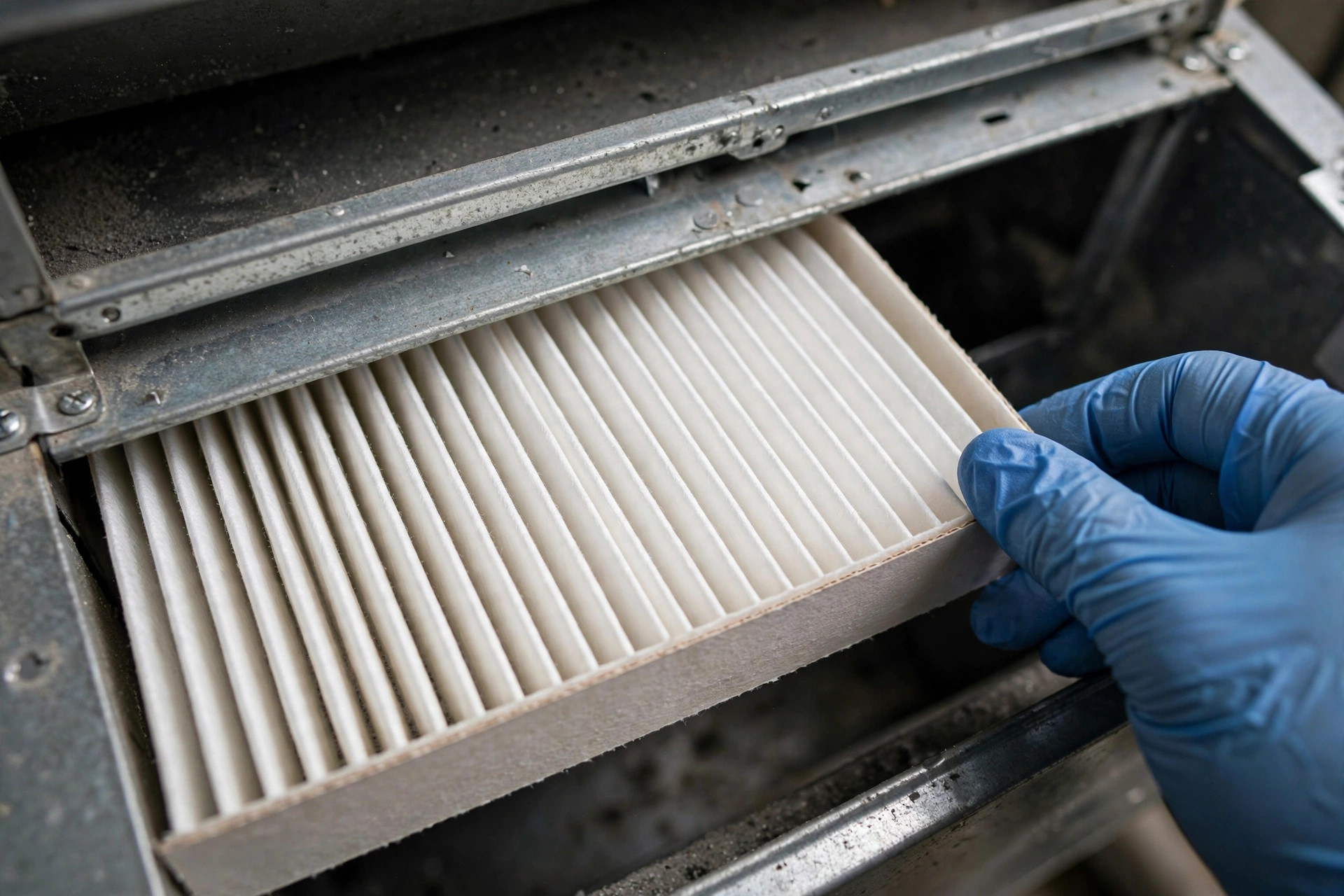
Slide the old filter out of the air handler or return grille and hold it up to the light. If you can't see light through it, replace it. Most Marco Island homes should check monthly and replace every 30 to 60 days — salt air, humidity, and pets load filters faster here than inland, and because Floridians cool nearly year-round, the filter racks up hours that a northern system never sees. Match the size exactly (printed on the filter frame) and mind the arrow, which shows airflow direction toward the blower. The five minutes this takes prevents frozen coils, protects the blower motor, and keeps your electric bill down.
Fix 3: Reset the Breaker — Once
Your AC runs on dedicated circuits: one for the indoor air handler, one for the outdoor condenser. A storm surge or a momentary fault can trip a breaker and silence the whole system. Open the panel, find the AC breakers, and flip any that sit in the OFF or halfway position firmly to OFF, then back to ON.
The "once" matters. If the breaker trips again immediately or shortly after, stop and do not keep resetting it. A breaker that keeps tripping is warning you about a genuine electrical fault — a failing capacitor, a short in the wiring, or a locked compressor — and forcing it on risks damage or a fire. Turn the system off at the disconnect and thermostat, and call for HVAC repair to find the root cause.
Fix 4: Clear and Clean the Outdoor Condenser
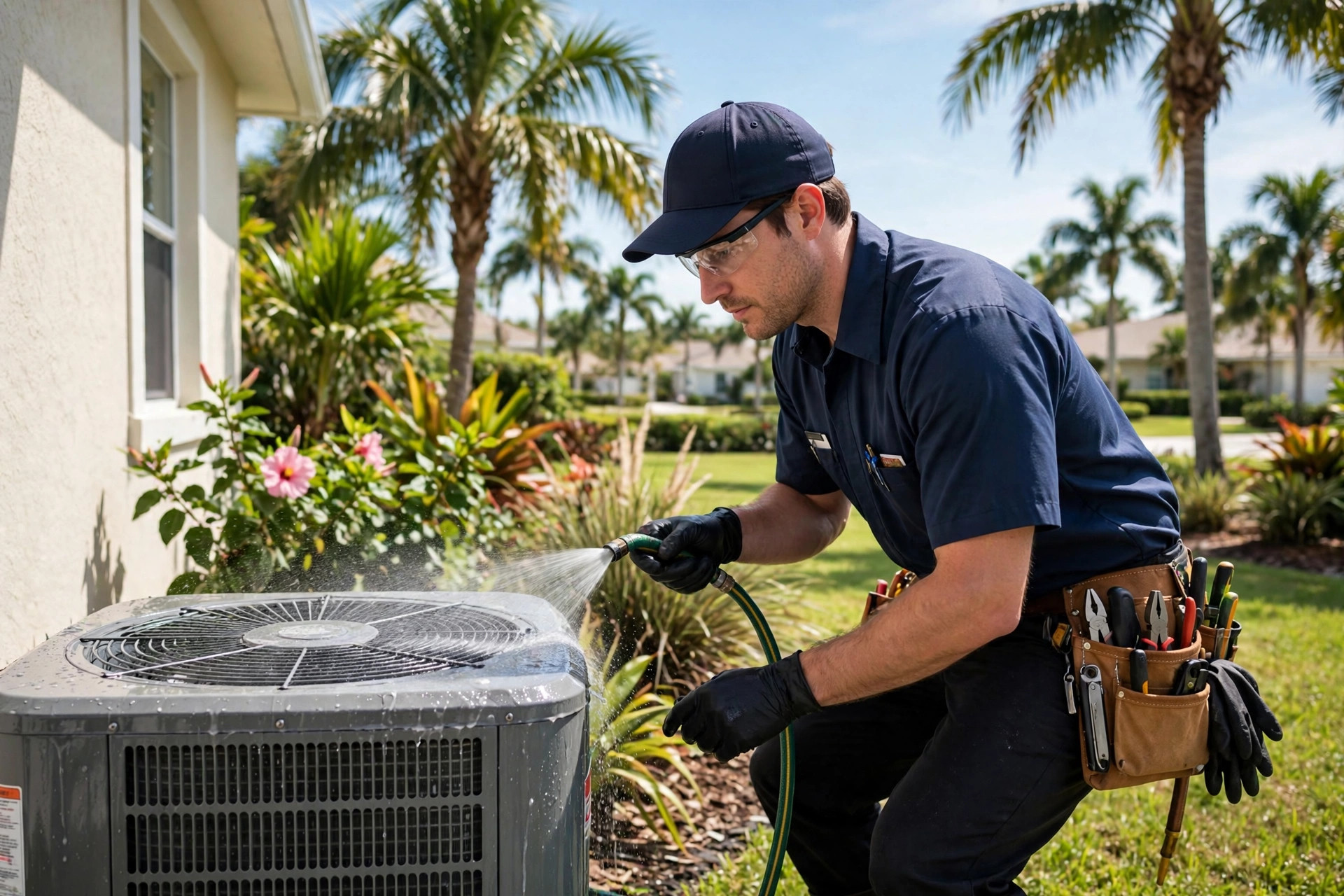
The outdoor unit breathes — it pulls air through the condenser coils to dump heat from your home. When salt film, sand, leaves, mulch, or grass clippings choke the fins, heat transfer suffers, head pressure climbs, and the compressor works harder until something gives. On Marco Island, the salt air is the quiet culprit: a thin crust of salt residue builds up on fins and coils even without visible debris.
Here's the safe way to clean it: turn off power at the outdoor disconnect switch beside the unit (and the breaker, for good measure). Clear at least two feet of space on all sides — trim grass, pull back mulch, move stored items. Pick leaves and debris out by hand, then rinse the coils with a garden hose, spraying from the inside out at low pressure to push dirt away from the fins. Never use a pressure washer: condenser fins bend easily, and bent fins block airflow just as effectively as dirt. This is also a good moment to straighten small patches of bent fins with a cheap fin comb from the hardware store. Restoring power, the system should run cooler and quieter — and during the hottest months, that cleaner coil translates directly into better cooling.
Fix 5: Clear the Condensate Drain Line
Your AC wrings gallons of moisture out of Marco Island's humid air every day, and all of it leaves through a small PVC drain line. Algae and sludge grow fast in that warm, dark pipe, and when it clogs, water backs up into the drain pan. Most systems have a float switch that shuts the entire unit down when the pan level rises — a completely "dead" AC that is actually protecting you from water damage.
Locate the drain line near the indoor air handler — it's the PVC pipe that runs to a floor drain or outside. There's usually a T-shaped access vent with a cap. For an accessible clog, hook a wet/dry vacuum to the outdoor end of the line and suction for a couple of minutes; you'll be surprised what comes out. For prevention, pour a cup of white vinegar (or a 50/50 vinegar-water mix) into the access vent every month or two during cooling season to kill algae. Never use bleach, which can corrode fittings and produce fumes. Once the clog clears, the float switch resets and cooling returns. If the line keeps clogging or the pan overflows repeatedly, the line may need professional cleaning or rerouting.
Fix 6: Thaw a Frozen Evaporator Coil
Ice on the copper lines at the outdoor unit or a sheet of frost visible inside the air handler means the evaporator coil has frozen — usually because of restricted airflow (dirty filter, blocked returns) or low refrigerant. Running the system frozen damages the compressor, so the safe DIY move is a controlled thaw: turn the thermostat to Off for cooling but switch the fan to On (or just set it to "Fan"). Room-temperature air moving across the coil melts the ice in a few hours.
Put a bucket or towels under the air handler first — a frozen coil releases a lot of water when it thaws. After it's fully thawed, replace the filter (Fix 2) before restarting. If the coil freezes again quickly with a clean filter, stop there: repeat icing with good airflow points to low refrigerant, which means a leak only a certified technician can fix. Never chip at the ice with tools — coil tubing is thin aluminum and punctures easily.
Fix 7: Open Vents and Check the Indoor Switch
Walk through the house and make sure supply vents and return grilles are open and unblocked — furniture, rugs, and closed vents in unused rooms starve the system of airflow and unbalance the whole house. Marco Island seasonal homeowners sometimes return to find supply vents closed from their departure checklist, which is fine to reverse on return.
Also check the small flip switch mounted near the indoor air handler or furnace. It looks like a light switch and is wired as a service disconnect — and if someone bumped it to OFF, the whole indoor unit goes dead. Flipping it back to ON restores power. It's one of the simplest "repairs" in the book and still catches people out.
What Not to Touch — Call a Pro for These
Drawing the line keeps you safe and protects your warranty. Leave these to a licensed technician, no exceptions:
- Refrigerant and anything on the sealed system. Low refrigerant means a leak that must be found and repaired; only EPA-certified technicians can handle refrigerant, and guessing at it destroys compressors.
- Capacitors, contactors, relays, and wiring. Capacitors store a charge even with power off and can shock you; contactors and boards carry 240 volts. Burn marks, humming without starting, and repeated breaker trips all belong to a technician.
- The compressor itself. It's a sealed, pressurized, high-voltage component — the most expensive part in the system. Anything that looks like a compressor problem needs professional diagnosis before anyone approves a compressor replacement.
- Gas-fired components (on dual-fuel/heat-pump hybrid setups) and ductwork inside walls or attics that would require cutting access.
When in doubt, the rule is simple: if it needs tools beyond a screwdriver and doesn't involve filters, thermostats, breakers, drains, or hose rinsing, schedule service instead of improvising.
Marco Island Tips: Salt Air, Humidity, and Seasonal Homes
Marco Island's coastal climate adds a few wrinkles the generic DIY guides skip. Salt air corrodes outdoor components faster than inland air, so rinse the condenser monthly rather than seasonally — that salt film also coats fins between cleanings. High humidity means your condensate line produces more water and clogs faster, so the monthly vinegar flush actually matters here rather than being optional.

Seasonal homeowners should leave the thermostat at 78–80°F while away (not off) — this controls humidity and prevents mold, keeps the condensate line active, and avoids the massive startup load of cooling a heat-soaked house on return. Ask your maintenance company about seasonal tune-ups timed to your return so a pro verifies refrigerant charge, capacitors, and contactor condition before the heavy season.
When DIY Ends and the Technician Begins
Work through the fixes in order, and you'll solve a surprising number of cooling problems yourself — filters and thermostats alone settle most of them. Keep a short note of what you tried and when; it makes a technician's diagnosis faster and cheaper if you do need one. But respect the line: refrigerant, electrical parts, and anything that trips a breaker twice means professional diagnosis. For the problems beyond DIY, Marco Island AC Services handles everything from precise root-cause HVAC repair to 24/7 emergency AC repair when cooling can't wait — call +1 (239) 880-1889 any day between 7AM and 8PM.