- The Quick Answer: Repair vs Replace by AC Part
- Compressor: Why Failed Compressors Get Replaced, Not Repaired
- Evaporator & Condenser Coils: Leaking Coils Get Replaced
- Control Board (PCB): Replaced as a Unit
- Capacitor & Contactor: Replaced — Cheap and Routine
- Fan Motors, Thermostat & Refrigerant Components
- How a Technician Decides: The Repair-vs-Replace Test
- When the Whole System Should Be Replaced Instead
- What to Ask Before You Approve a Parts Repair
The Quick Answer: Repair vs Replace by AC Part
When your air conditioner quits on a 95°F Marco Island afternoon, the question that matters is rarely "can it be fixed?" — it is what failed, and whether that specific part is worth fixing. Here is the honest part-by-part verdict before we get into the details:
Replaced, not repaired: compressor, evaporator coil (if leaking), condenser coil (if leaking), control board (PCB), capacitor, contactor, fan motors, thermostat.
Repairable: refrigerant line-set leaks at accessible joints (sometimes), condensate drain clogs, dirty coils (cleaned, not "repaired"), ductwork issues, corroded wiring connections.
Notice the pattern: sealed or precision parts get replaced; maintenance-type problems get fixed. If a technician tells you they are "repairing the compressor," ask exactly what they mean — odds are they are replacing it, which is the correct industry fix. For a full picture of what a service visit involves, see our guide to what to expect during an AC repair visit.
Compressor: Why Failed Compressors Get Replaced, Not Repaired
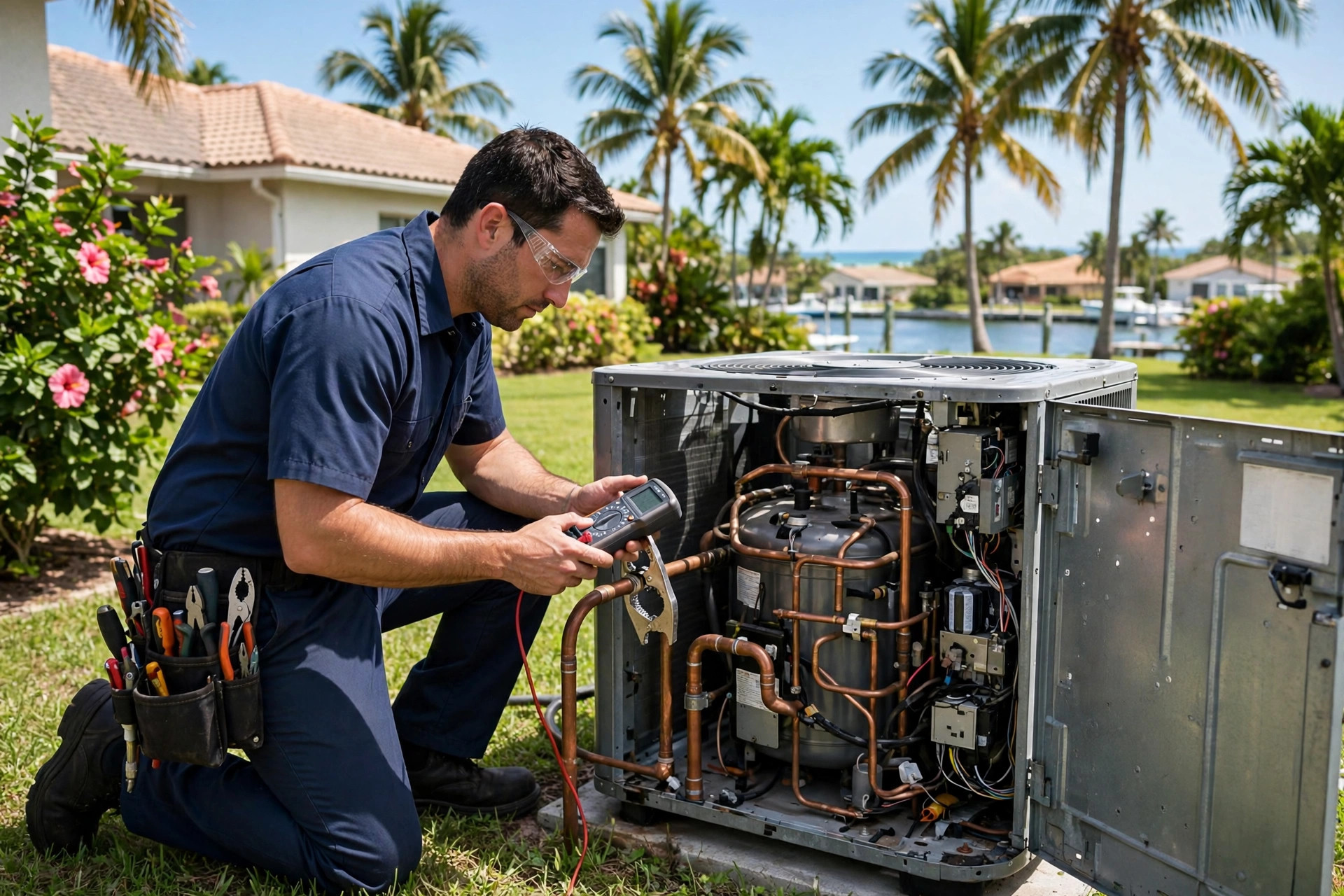
The compressor is the heart of your AC — it pumps refrigerant through the sealed circuit. It is also a hermetically sealed component, which is exactly why the answer to "can ac compressor repair work?" is almost always no.
Inside that welded steel can are pistons or scrolls, valves, and motor windings machined to factory tolerances. Once internal damage happens — a seized bearing, a shorted winding, a valve failure — there is no practical way to open, service, and reseal it in the field. Manufacturers do not supply internal repair kits, and rebuilding a compressor outside a factory setting is neither cost-effective nor reliable, a point industry sources like northnjhvac.com and acomfort.us agree on.
What can be repaired are things attached to the compressor, not inside it: a failed hard-start kit, a weak run capacitor that is preventing startup, burned terminal connections, or a damaged service valve. A good tech will rule these out before condemning the compressor itself.
Two scenarios change the decision about a compressor failure:
- System under 10 years old and under warranty: replacing the compressor makes sense. You typically pay only labor and refrigerant while the part itself is covered.
- System over 10–12 years old or out of warranty: industry guidance (brownsheating.com, meyersheatingac.com) is blunt — dropping a new compressor into an old system often just buys a little time before the next expensive part fails. A full AC replacement is usually the smarter investment, and you gain modern SEER2 efficiency.
On Marco Island, there is an extra wrinkle: salt air corrodes outdoor condensers faster than inland units, so compressors here often die from external corrosion and electrical stress rather than simple old age. Either way, the fix is the same — replacement.
Evaporator & Condenser Coils: Leaking Coils Get Replaced
The evaporator coil (inside your air handler) and the condenser coil (inside the outdoor unit) are thin-walled copper or aluminum tubing — and on Marco Island they live a hard life. Salt-laden coastal air attacks aluminum fins and copper tubing, and formicary (formic acid) corrosion from household chemicals can eat pinholes in copper from the inside.
Can a leaking coil be repaired? Technically, a small leak in an accessible spot can be brazed — but almost no technician recommends it as a lasting fix, because finding every leak in a fin-covered coil is difficult and new leaks usually follow the first. Sources like fenwickwaychoffs.com put it plainly: with a leaking evaporator coil, replacement is the only permanent solution.
Industry rule of thumb: replace the coil when there is one confirmed leak and the system is under 10 years old; replace the system when there are multiple leaks, heavy corrosion, the unit still uses R-22 refrigerant (no longer manufactured — it now costs $50–$150/lb to source, per cltappliance.com), or the repair cost approaches half the price of new equipment.
National pricing guides report evaporator coil replacement at roughly $800–$2,000 and condenser coil replacement at $1,000–$2,500 — real numbers, but get a local quote, because Marco Island's corrosion rates and unit sizes swing both ways. A coil that is merely dirty is a different story: a professional coil cleaning ($100–$250 standalone, or included in a tune-up) restores airflow and efficiency. That is why routine AC maintenance matters so much on the coast — cleaning catches corrosion early.
Control Board (PCB): Replaced as a Unit
The control board — the printed circuit board that sequences the compressor, fan motors, and safety switches — is not field-repairable. Nobody solders individual components on an AC board; when diagnostics trace a failure to the board (burned relay contacts, corroded traces, lightning damage), the whole board gets swapped for a new one matched to your system's make and model.
That is actually good news, because a board swap is a same-visit fix in most cases. Pricing guides list control board replacement around $200–$600 installed. The important diagnostic step is making sure the board is truly the failure and not just the messenger — a board that shut down because a high-pressure switch or float switch told it to does not need replacing. This is exactly the kind of root-cause HVAC diagnosis that separates a quick fix from a repeat callback.
Capacitor & Contactor: Replaced — Cheap and Routine
These two are the AC world's most common failures and, confusingly, the most misunderstood. Capacitors and contactors are never repaired — they are replaced. There is nothing to repair inside them: a capacitor is a sealed energy-storage cylinder, and a contactor is a relay switch with sacrificial contacts.
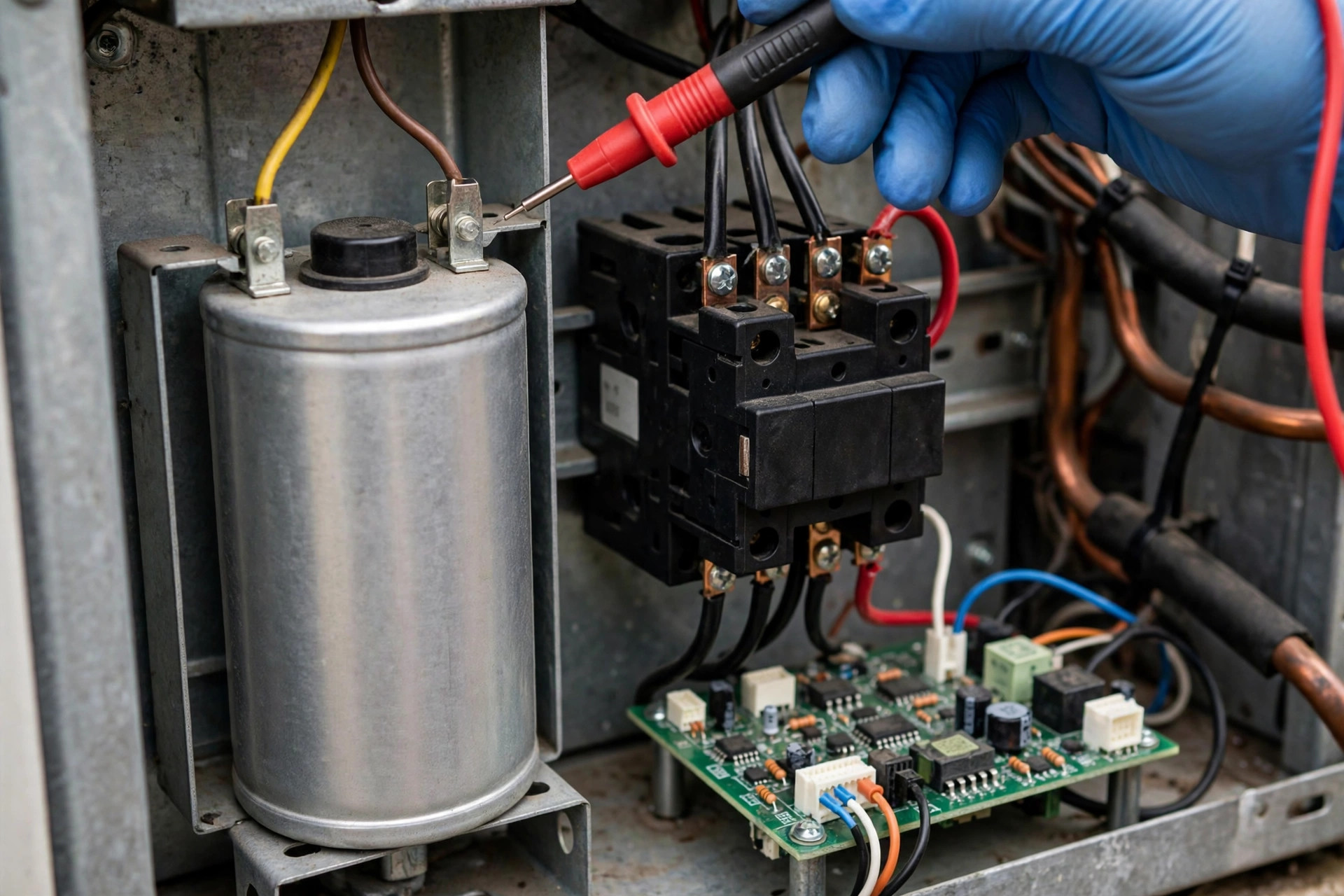
What makes them notable is the economics. The parts themselves cost $10–$80; most of the $150–$400 installed bill is the diagnostic visit and labor. A failing capacitor is the classic "unit hums but won't start" symptom, and Florida heat is brutal on them — constant running hours cook them faster here than up north. Since both parts age together, most honest technicians replace the pair in one visit.
One safety note worth repeating from sources like hometips.com and hvaclaboratory.com: capacitors hold a dangerous electrical charge even with power off, and contactor work involves 240V. These are the cheapest AC repairs — not the place to DIY.
Fan Motors, Thermostat & Refrigerant Components
- Condenser and blower fan motors ($200–$700 installed): replaced, not repaired. A burned-out motor gets swapped for an equivalent; the bearings and windings inside are not serviceable.
- Thermostats ($100–$300 installed): replaced. There is nothing inside a modern thermostat worth fixing.
- Refrigerant lines and leak repair ($200–$1,500 with recharge): genuinely repairable when the leak is at an accessible braze joint, service valve, or fitting. But EPA rules require certified recovery and precise recharge by weight — and repeated "top-offs" of a known leak are not a real fix.
- Condensate drain ($100–$250): the most genuinely repairable item on the list. Clogged drain lines — a constant issue in Florida's humidity — get flushed and treated, not replaced.
How a Technician Decides: The Repair-vs-Replace Test
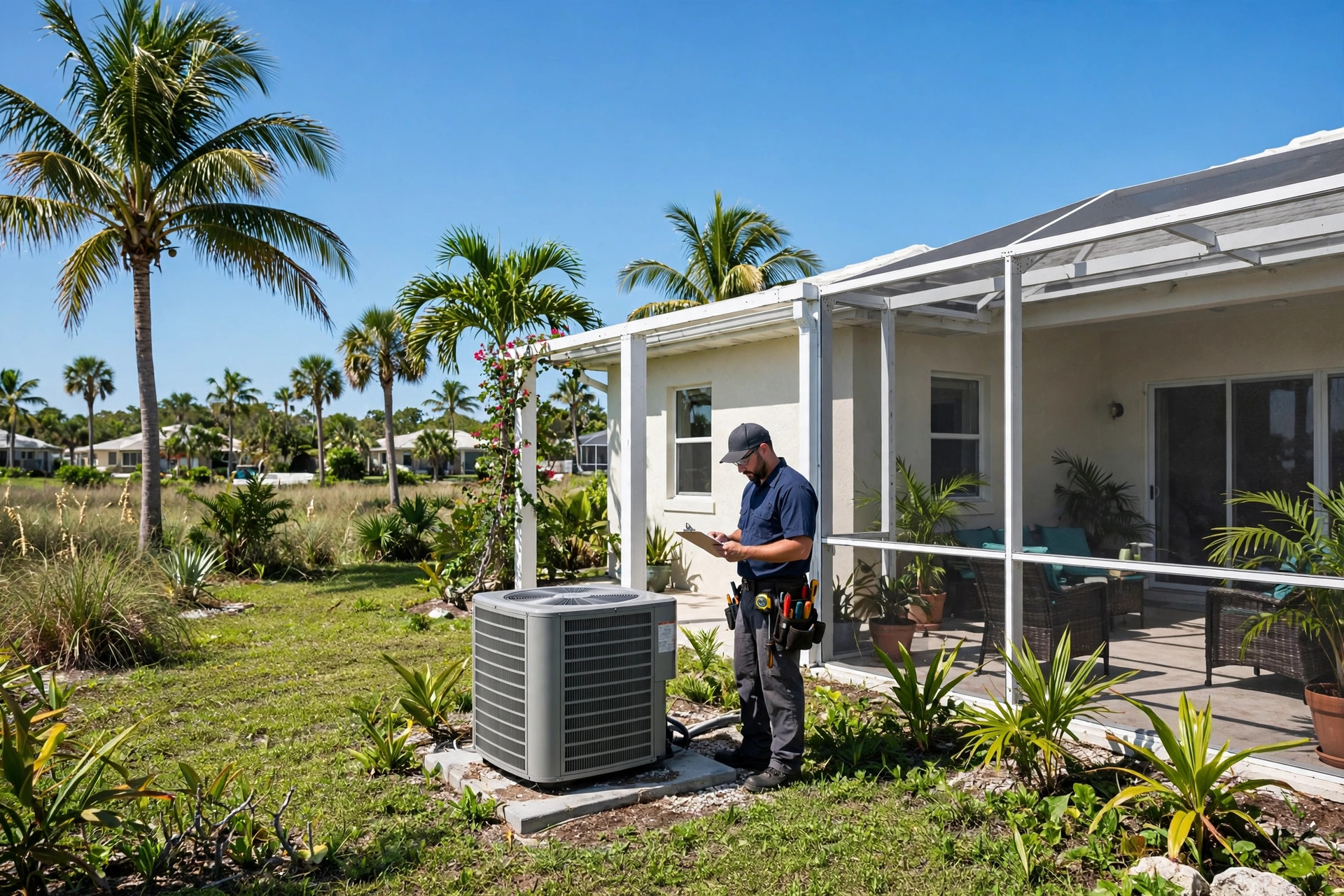
You do not have to memorize all of this — a proper diagnosis answers it for you. Here is the logic a good technician works through, and it is worth knowing so you can follow along:
- Is it the part or the symptom? A compressor that won't start may actually be a $250 capacitor problem. A coil that looks "bad" may just be dirty. Diagnosis comes before quotes.
- Is the system still under warranty? Under-10-year systems with maintenance records usually have parts coverage — replace the part. Expired warranty flips the math.
- What's the age and condition of everything else? A new compressor in a salt-eaten condenser cabinet is a down payment on the next breakdown.
- What's the 50% rule? If the repair costs more than half of what a new system costs — or of the coil/component replacement threshold — replacement wins financially.
That is the sequence Marco Island AC Services follows on every call, and why we explain the options in plain language before doing any work.
When the Whole System Should Be Replaced Instead
Sometimes the honest answer is that no single part is worth fixing. Consider a new system instead of a parts repair when:
- Your unit is 12–15+ years old (the typical lifespan for well-maintained Florida equipment)
- It still uses R-22 refrigerant
- You've had two or more major repairs in the last two years
- The outdoor condenser shows advanced salt-air corrosion on fins and casing
- Your energy bills have climbed while comfort has dropped
A modern SEER2 system also buys you efficiency gains that chip away at Florida's cooling bills — which is why emergency AC repair sometimes ends with a replacement conversation instead of a compressor swap.
What to Ask Before You Approve a Parts Repair
Before you green-light any AC parts repair, ask your technician these five questions:
- What exactly failed, and what caused it — the part, or something upstream?
- Is this a replacement or an actual repair of the part?
- Is the part under manufacturer warranty, and am I only paying labor?
- Given the system's age, would this money be better spent toward replacement?
- What can I do (maintenance plan, coil coating, surge protection) to prevent a repeat?
If they can't answer the first two clearly, get a second opinion. For a deeper look at what a service call should feel like from the doorbell onward, read our walkthrough of what to expect during an AC repair visit.