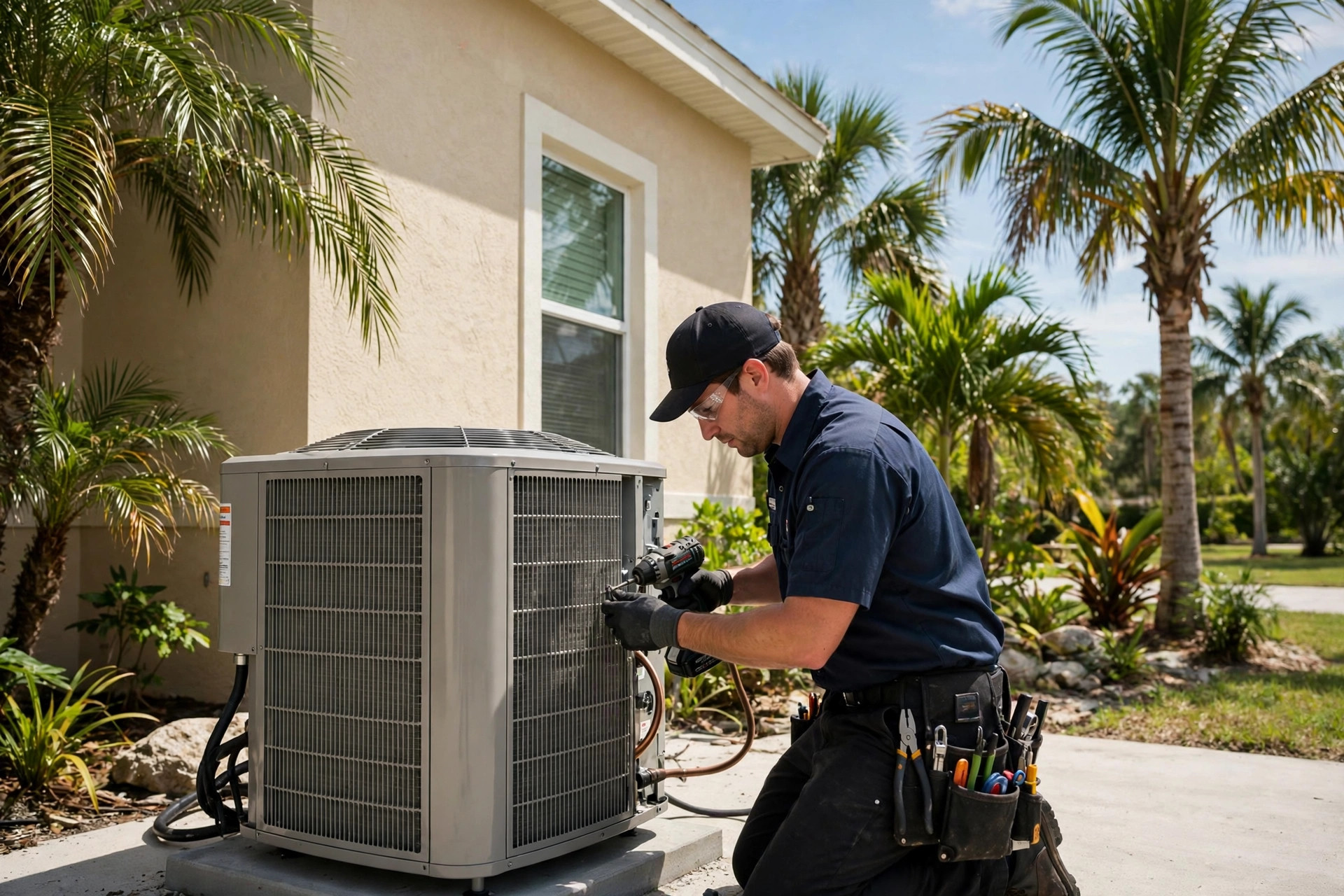
- Can You Finance an AC Repair in Marco Island?
- How Contractor Financing Usually Works
- The Deferred-Interest Trap: Read the Fine Print
- Home-Equity Loans and HELOCs
- Credit Cards and Retail Promotions
- Manufacturer Rebates and Utility Programs
- What to Compare Before You Sign Anything
- Red Flags That Signal a Bad Deal
- What About Financing Through Marco Island AC Services?
Can You Finance an AC Repair in Marco Island?
Yes — AC repair financing is widely available, and it's one of the most common ways homeowners handle big HVAC bills. A failed compressor, a leaking refrigerant line, or a full system replacement can run into the thousands, and very few people budget for that kind of surprise in the middle of a Southwest Florida summer.
The short version: many HVAC contractors offer financing at the point of sale through third-party lenders, so you can spread the cost across monthly payments instead of paying everything upfront. Financing is most common for major repairs (roughly $1,500 and up) and full system replacements, rather than routine service calls or minor fixes.
This guide covers the options realistically — how contractor financing works, the difference between 0% APR and deferred interest (it matters more than almost anything else), other ways homeowners pay, and exactly what to compare before you sign anything.
How Contractor Financing Usually Works
The most convenient route is financing arranged right through the HVAC company doing the work. Many contractors partner with lending institutions that specialize in home-improvement financing — names you'll see repeatedly include Synchrony, Wells Fargo, Service Finance, and GreenSky.
It's convenient because you get a single point of contact: one estimate covers the equipment, the installation, and the payment setup. Applications are often submitted during the in-home estimate, so you know your options on the spot. Approval for straightforward plans is frequently fast.
Contractor financing typically comes in two main forms:
- Promotional 0% APR offers — no interest for a set window, commonly 12 to 18 months (some run as long as 60 months). These usually require decent credit, generally around 640 or higher.
- Standard installment loans — fixed monthly payments over a set term, usually 3 to 10 years. Rates depend heavily on credit; borrowers with excellent credit may see rates starting around 7%, while weaker credit can push much higher.
One thing to know: some contractor financing programs allow the dealer to add a markup to the lender's base rate. That means two homeowners with identical credit can be quoted different APRs by different contractors — another reason to get everything in writing.
The Deferred-Interest Trap: Read the Fine Print
This is the single most important concept in HVAC financing, and it's where homeowners get burned most often.
A deferred-interest promotion — often advertised as "no interest if paid in full" — is not the same as 0% APR. Here's how it works: no interest accrues during the promotional period, but the lender silently tracks the interest that would have been charged at the standard contractual rate, which is frequently steep — often 25% to 30% APR, similar to a high-interest retail credit card.
The critical stipulation: the entire original balance must be paid in full by the promotional deadline — 12, 18, or 60 months after signing. If even a small amount of principal remains unpaid when the window expires, the lender retroactively applies that high rate to the entire original purchase amount, from day one. That retroactive interest is added to your balance immediately, turning what was marketed as a free loan into a much more expensive debt.
A concrete example: retail credit cards with deferred-interest promotions disclose regular APR ranges like 17.99% to 29.99%. Miss the payoff deadline on a $9,000 system, and you could face thousands in retroactive interest overnight.
A true 0% APR promotion behaves differently: it charges no interest at all during the promotion as long as you make every payment on time, and any balance remaining at the end simply continues at the standard rate — no retroactive bomb.
Before signing any promotional financing agreement, ask point-blank: "Is this deferred interest or true 0% APR?" Get the answer in writing.
If you can't confidently pay off the full balance within the promotional window, a standard fixed-rate installment loan is usually the safer, more predictable choice.
Home-Equity Loans and HELOCs
If you've built meaningful equity in your Marco Island home, a home-equity loan or home-equity line of credit (HELOC) is often worth comparing against contractor financing.
- Rates: Home-equity loans tend to fall between roughly 7% and 10% as of 2026 — often lower than unsecured personal loans or standard contractor installment rates.
- Tax angle: Interest may be tax-deductible when the funds are used for home improvements, though you should confirm current rules with a tax professional.
- The risk: Your home is the collateral. Default on the payments and the lender can foreclose. HELOCs also typically carry variable rates, so your payment can rise over the life of the loan.
This option works best for homeowners with substantial equity and stable income — which describes a lot of Marco Island property owners, especially those with seasonal or second homes that have appreciated over the years.
Credit Cards and Retail Promotions
For mid-size repairs, a credit card — including retail cards like the Home Depot Consumer Credit Card, which offers promotional deferred-interest terms on qualifying installed HVAC purchases — can bridge the gap. But the same warnings apply:
- Standard credit-card APRs are high, often 17.99% to 29.99%.
- Deferred-interest promotions carry the same retroactive-interest risk described above: the balance must hit zero before the promotion ends, or interest is charged from the original purchase date.
- If you use this route, write yourself a payment schedule: divide the total by the number of promotional months, and pay slightly more than that figure each month to absorb rounding and statement timing.
Credit cards make the most sense for smaller repairs you can realistically clear in a few months — not for five-figure system replacements.
Manufacturer Rebates and Utility Programs
Before borrowing at all, check what's available to shrink the bill. Manufacturers periodically run promotions, and local utility providers offer energy-efficiency rebates — commonly ranging from $100 to $1,500 depending on the region and the equipment's efficiency rating.
Eligibility often depends on the specific model and may require the installer to be a program-approved contractor, so verify the requirements before committing to a purchase. High-SEER2 systems and heat pumps tend to attract the best incentives, which is worth knowing if your diagnosis comes back as "AC replacement" rather than a repair.
What to Compare Before You Sign Anything
Whether the financing comes from a contractor, a bank, or a card issuer, compare the same checklist:
- APR, not just the interest rate — APR includes origination and other fees, so it's the honest apples-to-apples number.
- Deferred interest vs. true 0% — ask directly, get it in writing.
- Term length — shorter terms mean higher payments but less total cost; longer terms lower the monthly hit but increase total interest.
- Fixed vs. variable rate — fixed locks your payment; variable can rise mid-term. For a multi-year payoff, fixed is usually safer.
- Fees — origination, application, late-payment, and any dealer markup baked into the rate.
- Early payoff terms — a loan with no prepayment penalty lets you cut total interest by paying faster. Some promotional plans penalize or complicate early payoff, so read the terms.
- Written itemization — your quote should list equipment, labor, permits, and every fee separately. A financing offer built on a vague estimate isn't one you can compare.
Red Flags That Signal a Bad Deal
Watch for these warning signs when a contractor pitches financing:
- Bait-and-switch tune-up ads. Ultra-cheap "tune-ups" that turn into high-pressure replacement pitches at your doorstep are a classic pattern. A legitimate AC maintenance visit is an inspection and service — not a sales ambush.
- Financing that can't be explained plainly. If the person selling the plan can't clearly state the APR, the term, the fees, and what happens at the end of the promotional period, walk away.
- Pressure to sign today. Real financing offers don't evaporate overnight. Take the paperwork home.
- No written quote. Verbal numbers mean nothing. Every charge — equipment, labor, refrigerant, disposal, permits — should be itemized before you decide how to pay.
- Financing only through one lender with no alternatives offered. You always have the right to arrange your own loan or pay another way.
What About Financing Through Marco Island AC Services?
Let's be straightforward: Marco Island AC Services does not publish any financing offers, payment plans, APRs, or partner lenders on its website. We won't invent one for this article.
What that means in practice: if you're facing a major AC installation, a heat pump upgrade, or an emergency AC repair that strains the budget, the honest next step is a conversation — not a checkout page. Call +1 (239) 880-1889 and ask about payment options for your situation. You'll get a real diagnosis, an itemized written estimate, and a clear explanation of what's available — and armed with the knowledge in this guide, you'll know exactly which questions to ask.
Note: this article is general consumer information about how HVAC financing typically works in the U.S. It is not financial advice. Terms, rates, and program availability change frequently — verify current details with any lender before making a decision.