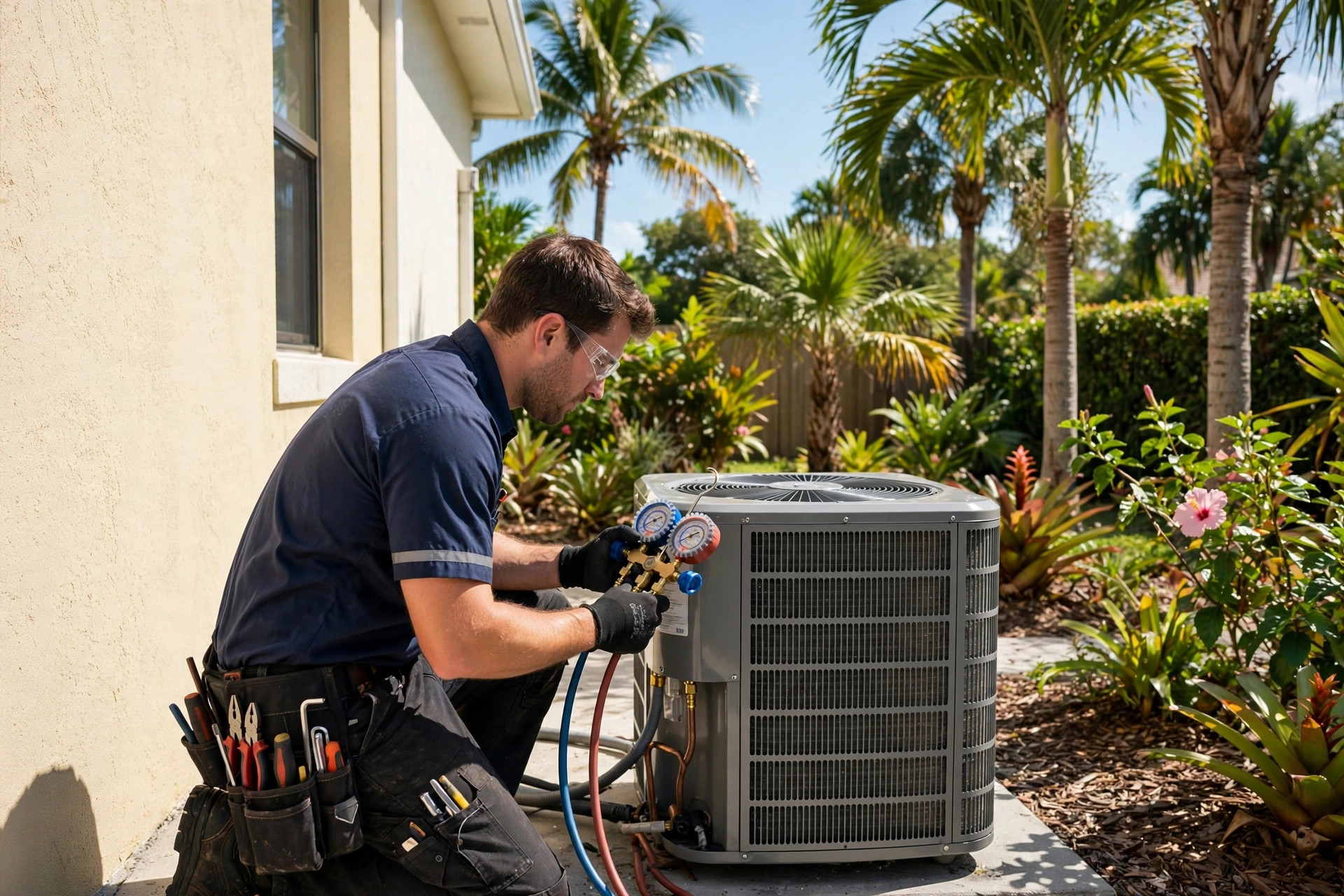
- Check These 5 Things First (5 Minutes, No Tools)
- A Dirty Air Filter Is the #1 Cooling Killer
- Your Evaporator Coil May Be Frozen
- Low Refrigerant Always Means a Leak
- The Outdoor Condenser: Salt Air's Favorite Victim
- Electrical Parts That Commonly Fail: Capacitors, Contactors, and Fan Motors
- When the Problem Isn't the Equipment: Ducts, Thermostat Location, and Undersized Systems
- When to Stop Troubleshooting and Call a Pro
If your air conditioner is running but your Marco Island home just won't cool down, you probably don't need to start with a repair bill — you need to start with a checklist. Most no-cooling service calls we diagnose trace back to a handful of causes, and several of them are safe for a homeowner to check in under five minutes. Work through this guide in order, and you'll either fix the problem yourself or know exactly what to tell your technician when you call.
Check These 5 Things First (5 Minutes, No Tools)
Before anything else, rule out the simple stuff. A surprising number of "broken" ACs are just misconfigured or mildly neglected.
1. Your thermostat settings. Make sure the thermostat is set to Cool, not Heat or Fan-only, and that the set temperature is at least a few degrees below the current room reading. Set the fan to Auto rather than On — in On mode the fan circulates air even between cooling cycles, which can make the air from your vents feel warm. If the display is dim or blank, replace the batteries.
2. Your air filter. Slide the filter out of your air handler and hold it up to a light. If you can't see light through it, it's clogged — and restricted airflow is the single most common cause of weak cooling. Swap in a fresh filter that matches the size and rating on your system, and give the system 30 minutes to recover.
3. Your vents and registers. Walk the house and confirm every supply and return vent is open and not blocked by furniture, rugs, or drapes. Closing vents in unused rooms does not help — it raises static pressure in your ductwork and can actually freeze the evaporator coil.
4. Your circuit breakers. If the indoor fan runs but the outdoor condenser unit is silent, check your electrical panel for a tripped breaker and the outdoor disconnect switch. Reset a tripped breaker once. If it trips again, stop — a breaker that keeps tripping is protecting you from a real electrical fault, and a professional HVAC repair is needed to find it.
5. The outdoor condenser unit. Step outside and look at your condenser. Leaves, palm fronds, grass clippings, or hedges crowding the fins block heat release and strangle cooling capacity. Clear debris from around the unit and trim vegetation back a couple of feet. Don't spray the unit with a hose while it's running — and don't open any electrical panels.
If cooling comes back after any of these steps, you're done. If not, the next sections explain what's most likely wrong — and which problems are yours to fix versus a technician's.
A Dirty Air Filter Is the #1 Cooling Killer
It sounds too simple to matter, but airflow is everything in air conditioning. Your evaporator coil — the indoor coil where refrigerant absorbs heat from your home's air — needs a steady stream of warm air passing over it to do its job. A packed filter starves it.
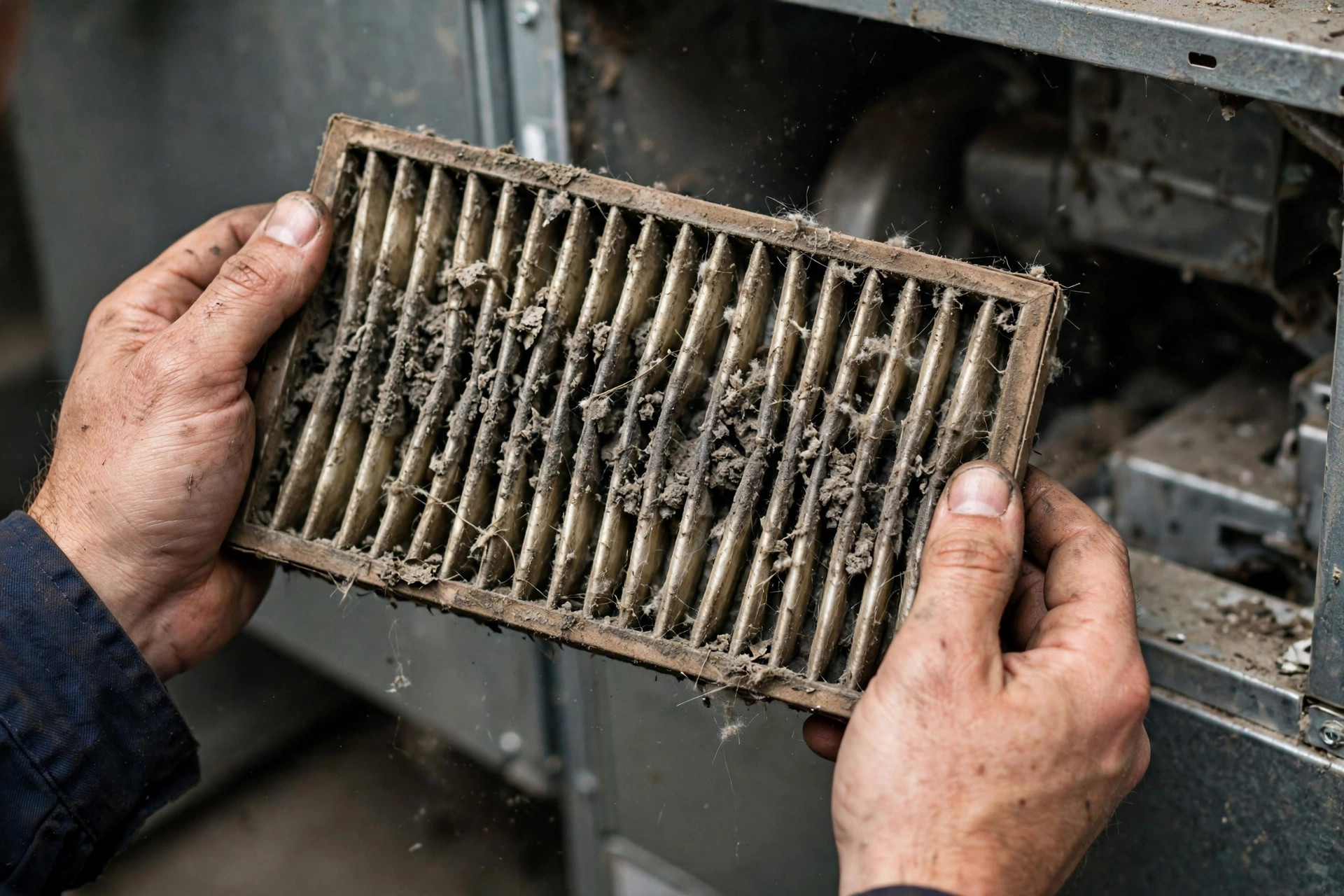
On Marco Island, filters clog faster than most homeowners expect. Between the coastal humidity, sand tracked in from the beach, and many homes running their systems nearly year-round, a filter rated for 90 days can be choking airflow in 30. If your system runs constantly but the air from the vents feels weak and only slightly cool, the filter is the first suspect. Make it a monthly habit to check it during cooling season — it's the cheapest maintenance you'll ever do.
Your Evaporator Coil May Be Frozen
Here's the cruel twist: low airflow can freeze your evaporator coil solid. When the refrigerant inside the coil can't absorb enough heat, the coil's temperature drops below freezing, and moisture from Marco Island's humid air condenses and turns to ice on it. That ice layer insulates the coil and blocks airflow entirely — so your system runs and runs while blowing warm air.
How to spot it: weak or warm airflow from the vents, ice visible on the copper refrigerant lines near the air handler, or water pooling under the indoor unit as ice melts.
What to do: turn the cooling OFF but leave the thermostat fan set to On so room-temperature air moves across the coil and thaws it — this typically takes a couple of hours. Then fix the airflow problem that caused it (usually the filter or blocked vents) before restarting. If the coil freezes again, you have a deeper issue — low refrigerant or a failing blower motor — and it's time for a technician.
Low Refrigerant Always Means a Leak
Refrigerant is the lifeblood of the cooling cycle: the compressor pressurizes it, the condenser coil releases heat outdoors, and the evaporator coil absorbs heat indoors. But refrigerant operates in a sealed loop — it is never "used up." If your system's refrigerant is low, there is a leak, full stop.
Signs of a leak: the system runs constantly without reaching the set temperature, cooling that has gradually declined over weeks or months, ice forming on the refrigerant lines, a hissing or bubbling sound near the outdoor unit, or noticeably higher indoor humidity than usual.
Recharging without fixing the leak is money poured into the sand — the charge will escape again. And under EPA Section 608 rules, only certified technicians may legally handle refrigerants such as R-410A, so this is strictly a professional job: leak detection, repair, then a recharge to the manufacturer's specification. If your technician finds the leak is in the evaporator coil or condenser coil on an older unit, ask for an honest repair-versus-replacement comparison before authorizing the work.
The Outdoor Condenser: Salt Air's Favorite Victim
Marco Island's salt air is beautiful and brutal. Salt mist settles on condenser coil fins and accelerates corrosion, while sand, pollen, and storm debris pack into the coil. A dirty or corroded condenser coil can't release heat effectively, so your system works harder, cools less, and the compressor runs hotter than it should.
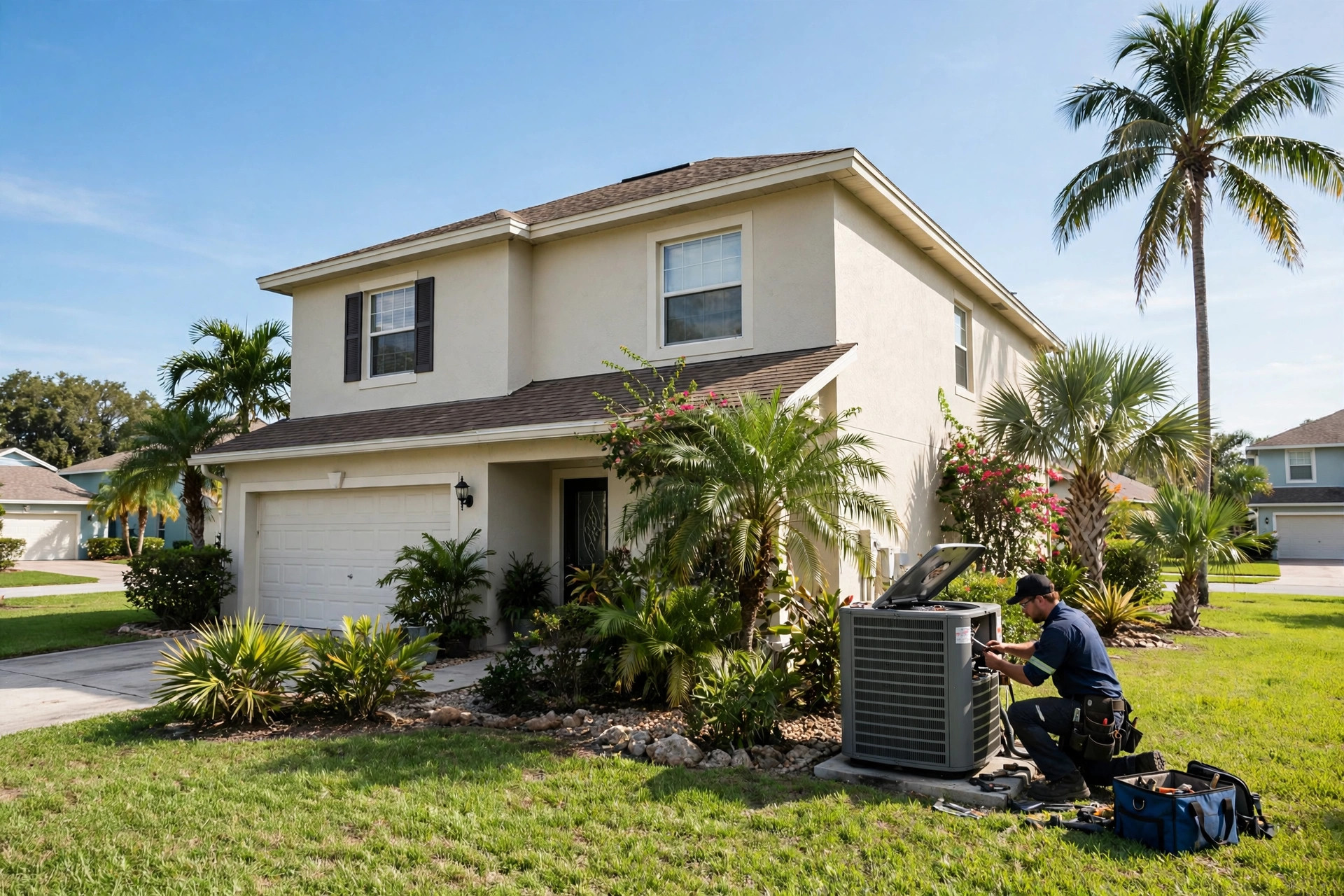
What you can do: keep at least two feet of clearance around the unit, clear debris after storms, and have the coil professionally washed as part of annual maintenance — coil washing uses the right pressure and cleaning agents so the delicate fins aren't damaged. If you see heavy corrosion flaking off an older condenser, that's worth a technician's assessment, because corroded coils eventually spring refrigerant leaks.
Electrical Parts That Commonly Fail: Capacitors, Contactors, and Fan Motors
Your AC's electrical components do hard duty in Florida heat. A few fail often enough that any technician recognizes the symptoms immediately:
- Start capacitors give your compressor and condenser fan motor their starting jolt. When one fails, the outdoor unit hums but won't start — or starts and stops. It's one of the most common summer failures, and it's a quick, inexpensive repair for a technician.
- Contactors are the electrical switches that tell the condenser to run. Pitted or burned contactor points can keep the outdoor unit from starting at all.
- Condenser fan motor failure is serious: with the fan dead, the condenser can't reject heat. If you see the fan isn't spinning, shut the system off — running without condenser airflow can destroy the compressor.
Electrical diagnosis involves high voltage, so once your five-minute checks are done, this is firmly technician territory.
When the Problem Isn't the Equipment: Ducts, Thermostat Location, and Undersized Systems
Sometimes every component works — but cooling still disappoints. Leaky or disconnected ductwork in a hot attic can lose a large share of your cooled air before it ever reaches the rooms. A thermostat placed near a heat source, or a poorly calibrated one, misreads the home's temperature and short-cycles the system. And on the hottest Marco Island afternoons, a system that was sized before an addition or renovation may simply be undersized for the load — it runs all day and never quite catches up.
These are judgment calls that benefit from a professional assessment, especially if your system is 12–15 years old or you're seeing uneven cooling between rooms. If the diagnosis points toward a new system, modern high-SEER2 equipment sized with a proper load calculation will cool more evenly and cost less to run than nursing along an undersized or failing unit — see our guide to AC installation for Marco Island homes.
When to Stop Troubleshooting and Call a Pro
You've worked the checklist; the system still won't cool. Stop and call a Marco Island technician if you notice any of these:
- Ice keeps returning after you've fixed the airflow basics
- Warm air persists with a clean filter and correct thermostat settings
- You hear grinding, screeching, or repeated breaker trips
- You smell burning or see water leaking from the air handler
- The outdoor unit hums but the compressor or fan won't start
When you call Marco Island AC Services at +1 (239) 880-1889, tell us what you already checked — it speeds up the diagnosis. And if cooling fails completely on a brutal afternoon, our 24/7 emergency AC repair line is there for exactly that.
Most no-cooling failures didn't start today — they started months ago as a dirty filter, a neglected coil wash, or a small leak nobody caught. An annual tune-up catches nearly all of them before they cost you a summer weekend. On Marco Island, your AC isn't optional equipment. Treat it that way.