- The Short Answer: Repair Fixes, Installation Replaces
- What AC Repair Actually Covers
- What AC Installation Actually Covers
- Repair or Install? A Decision Framework That Actually Works
- What Installation Day Looks Like
- What a Repair Visit Looks Like — and What It Should Cost
- Questions to Ask Before You Approve Either Service
- The Bottom Line for Marco Island Homeowners
The Short Answer: Repair Fixes, Installation Replaces
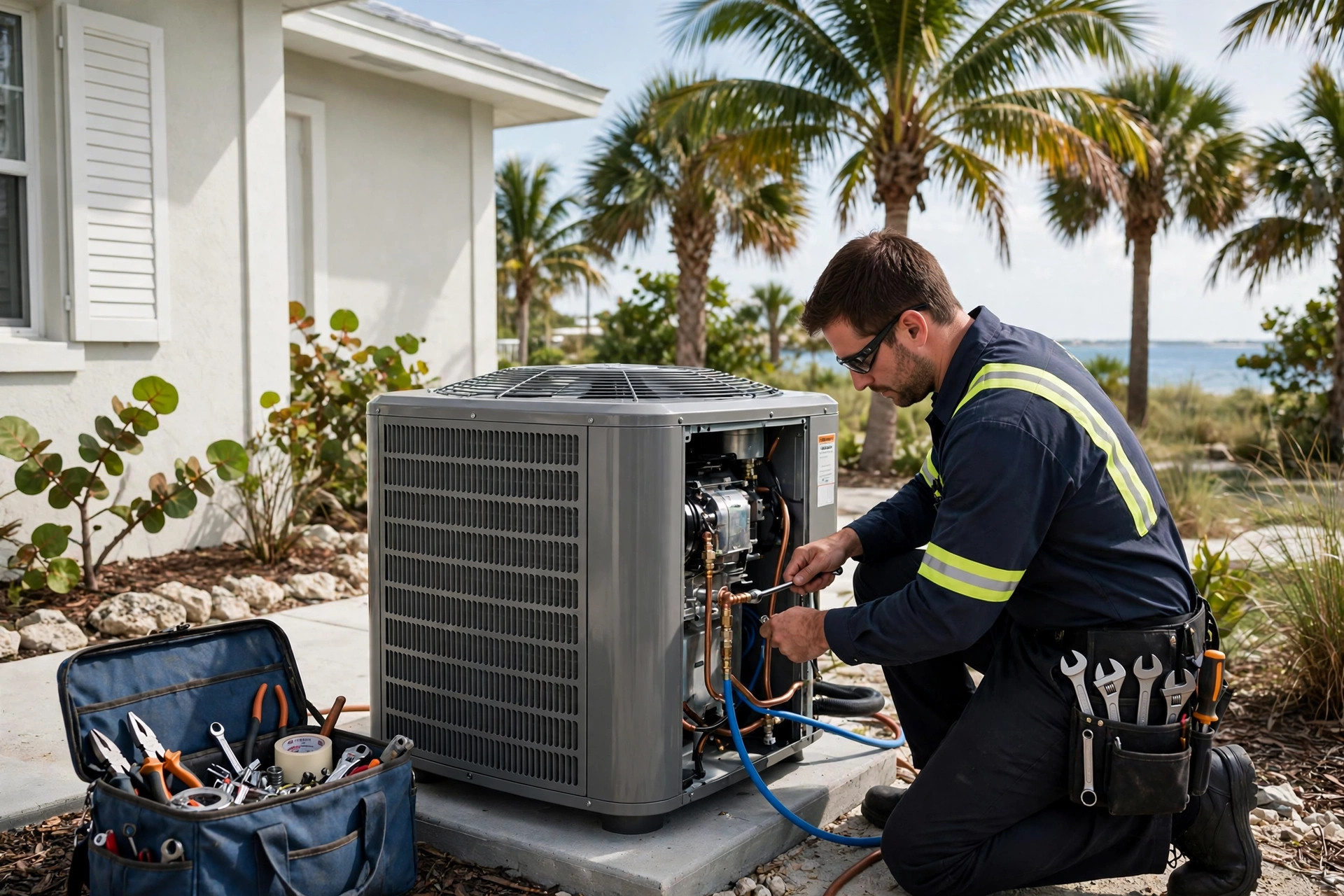
Every "should I repair or install?" question comes down to one distinction that homeowners often blur: AC repair keeps your existing system running, while AC installation gives you a new system. They are different services, with different visits, different quotes, and different results — and choosing the wrong one wastes money in opposite directions. Repairing a system that is truly finished throws good money after bad; installing a new system to fix a $200 part is the most expensive way to solve a small problem.
Here is the short version for Marco Island homeowners: if your system is relatively young, has been reliable, and has one clear fault, repair it. If it is old, keeps breaking down, costs more and more to run, or needs a major component, price a new installation before you approve another big repair. The rest of this guide explains what each service actually covers, what happens on the day, and how to compare the two honestly — so you can judge any quote you receive against something real.
What AC Repair Actually Covers
An AC repair visit is diagnostic work first and parts second. The technician's job is to find the root cause of a symptom — warm air, short cycling, strange noises, water around the indoor unit, a breaker that keeps tripping — and fix that cause, not just quiet the symptom.
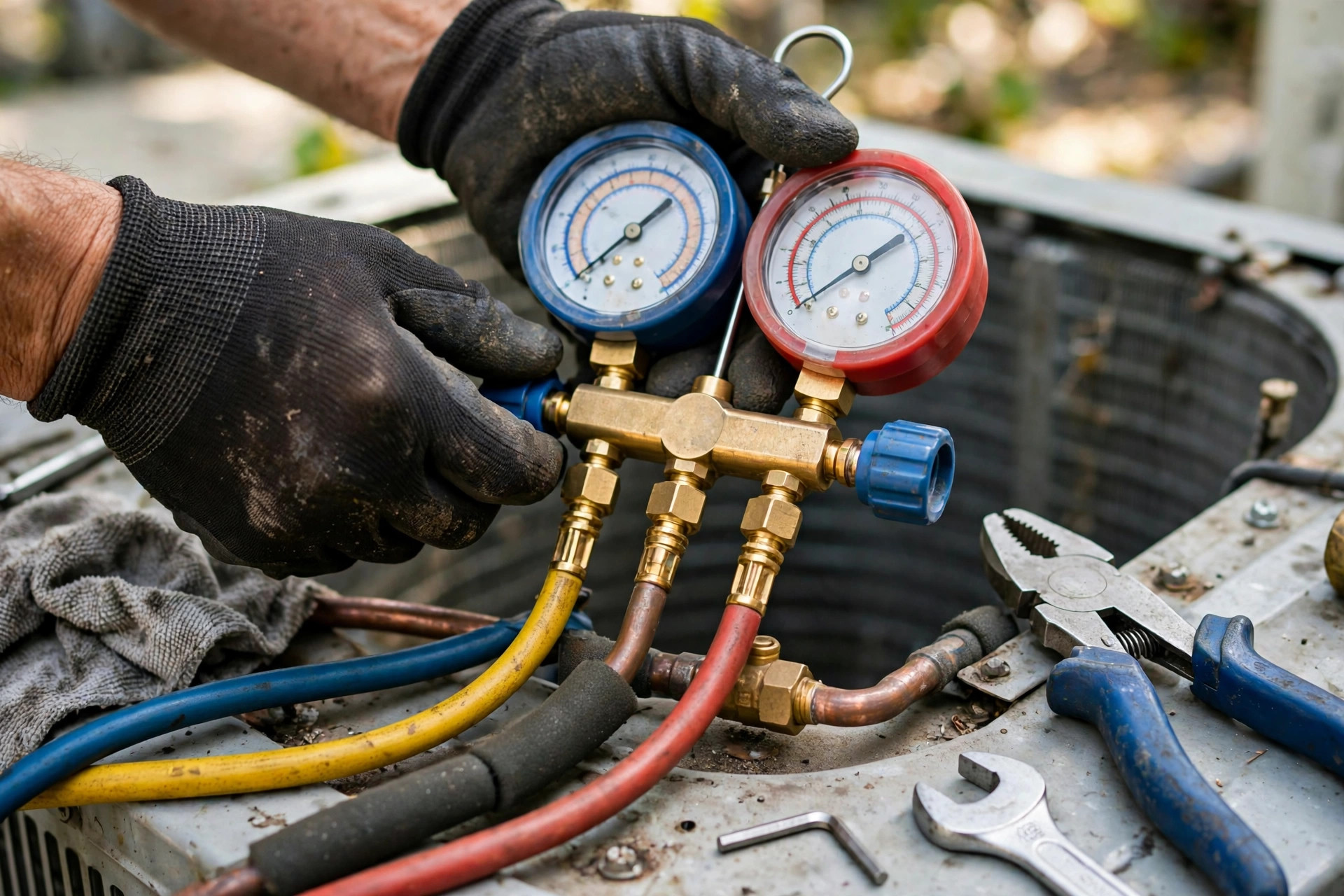
Typical repair work includes:
- Electrical components: failed capacitors, contactors, relays, and control boards. These are the most common failures in coastal Florida, where salt air corrodes connections faster than inland.
- Refrigerant problems: finding and sealing leaks, then recharging the system to the correct level. A top-up without a leak repair is a temporary fix, not a repair.
- Airflow problems: failed blower motors, dirty evaporator coils, blocked condensate drains, and thermostat faults that leave rooms unevenly cooled.
- Mechanical failures: worn fan motors, damaged fan blades, and compressor problems — the most expensive category, and the one most likely to tip a decision toward installation.
What AC Installation Actually Covers
An AC installation is a construction project, not a service call. It starts before anyone touches your old unit, with sizing and selection: a proper installer performs a Manual J load calculation — accounting for your home's square footage, insulation, windows, ceiling height, and sun exposure — rather than simply matching the tonnage of the unit being removed. In Marco Island, that matters more than most places: a system sized for a year-round family home behaves differently in a seasonal condo that sits empty for months, and an oversized unit short-cycles, cools poorly, and leaves humidity behind.
Installation itself includes:
- Removal and disposal: safe recovery of the old refrigerant (required by law and handled only by certified technicians), disconnection, and removal of the old indoor and outdoor equipment.
- Setting new equipment: the outdoor condenser on a level pad and the indoor air handler, positioned for proper drainage, airflow, and service access.
- Connections: refrigerant lines, electrical supply and disconnect, thermostat wiring, and the condensate drain — which matters enormously in Florida's humidity, where a poorly run drain is one of the most common causes of later water damage.
- Ductwork review: checking accessible ductwork for leaks, poor sizing, or damage, and discussing any repairs before the new system is commissioned.
- Startup and commissioning: verifying refrigerant charge, airflow, supply and return temperatures, electrical readings, and thermostat operation, followed by a walkthrough showing you the filter location, thermostat controls, and warranty terms.
Repair or Install? A Decision Framework That Actually Works
No single rule decides every case, but four factors together almost always point the right way:
1. Age. Most central air conditioners last 12 to 15 years, but Florida systems work harder than most — long cooling seasons, high humidity, and salt air mean Marco Island units often reach the end of that range sooner. Under 8 to 10 years with a good maintenance history, repair is usually the smart call. Over 12 to 15 years, start pricing installation alongside any major repair.
2. Repair history. One breakdown in three years is bad luck. Three breakdowns in two summers is a pattern, and patterns cost more than any single invoice suggests — in money, in lost comfort, and in emergency-call timing.
3. The $5,000 rule. HVAC guides widely cite this rule of thumb: multiply the system's age by the repair cost. If the result exceeds $5,000, replacement is usually more cost-effective. A 12-year-old system facing a $600 repair scores $7,200 — worth pricing a new unit. A 6-year-old system with a $300 repair scores $1,800 — repair it. Treat the rule as a guide, not a verdict, and weigh it against the other factors here.
4. Efficiency and refrigerant. Older systems using R-22 refrigerant are expensive to service because that refrigerant has been phased out, and a system rated at 10 or 12 SEER costs far more to run through a Marco Island summer than a modern unit. Under current federal standards, new Florida systems must meet at least 14.3 SEER2, and higher-rated systems — 16 to 18 SEER2 is a common sweet spot in Southwest Florida guides — can cut cooling costs noticeably over a long cooling season. If your bills have been climbing while your usage has not changed, efficiency alone can justify installation.
Two more Marco Island factors deserve weight. Seasonal homes: if you are away for months, reliability matters more than squeezing one more season out of an aging unit — a failure discovered on arrival in May is far worse than a planned spring installation. Condos and high-rises: access rules and limited outdoor space can complicate installation logistics, so start the conversation early rather than during an emergency.
What Installation Day Looks Like
Knowing the process helps you spot a rushed job. On a standard replacement, expect the crew to protect floors and work areas, shut down and recover refrigerant from the old system, remove the old equipment, and inspect the pad, connections, and ductwork before setting the new unit. The new condenser goes on a level pad, the air handler goes in, and refrigerant lines, electrical, thermostat, and drain connections are made and checked. Then comes the part that separates a proper installation from a shortcut: a full startup test of charge, airflow, temperatures, and controls, plus a walkthrough of your new system.
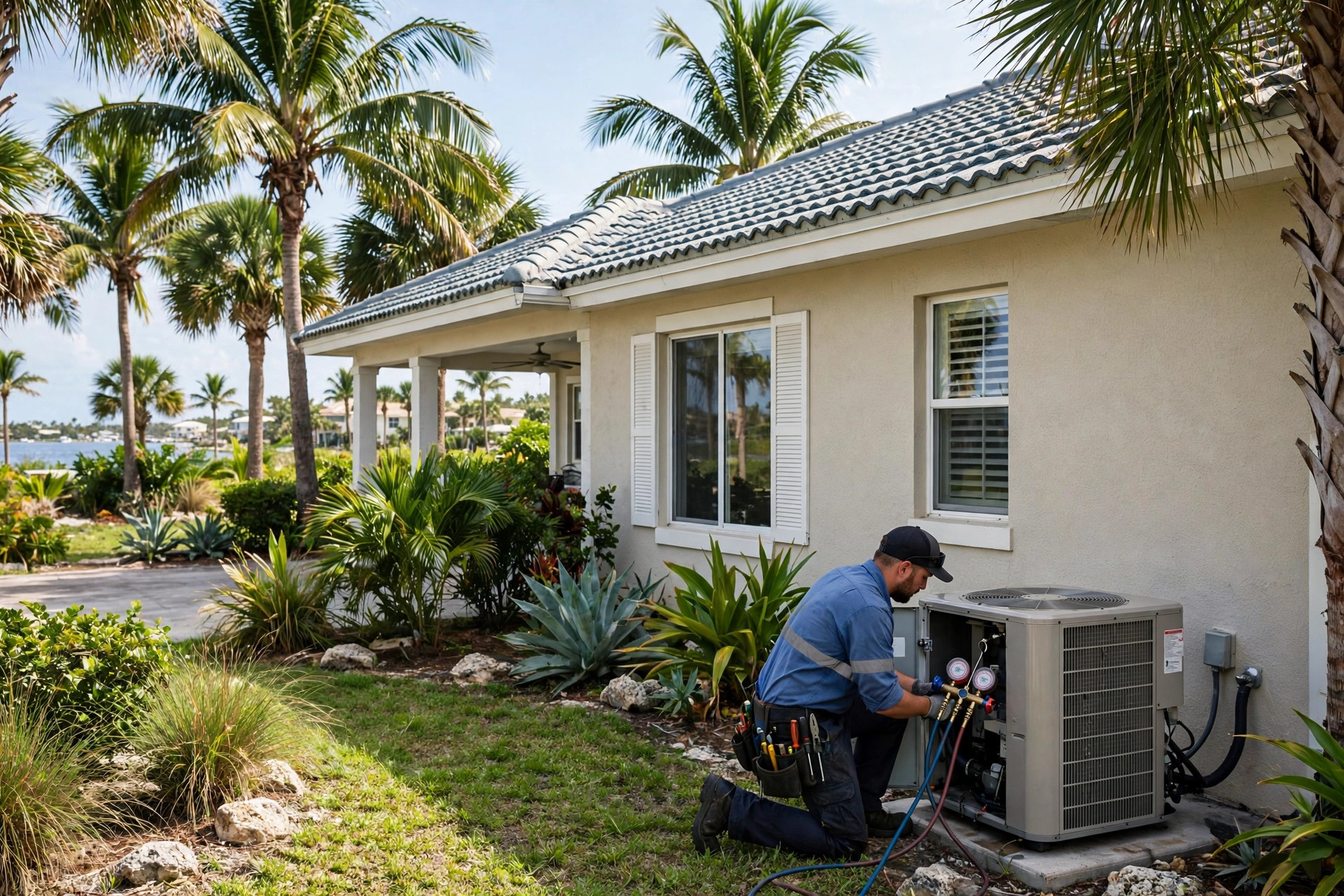
Southwest Florida installation guides put a standard job at 4 to 8 hours, with ductwork or electrical work potentially extending it to a second day. If a crew promises a full replacement in two hours flat, ask what steps they are skipping — the testing phase is usually the first to go, and it is the phase that catches the problems you would otherwise discover in July.
What a Repair Visit Looks Like — and What It Should Cost
A repair visit is shorter and narrower, but it should still follow a sequence: symptom check, diagnostic testing with gauges and meters, a written explanation and price before work starts, the repair itself, and a re-test proving the system now performs correctly. Be suspicious of any visit that jumps straight to a replacement recommendation without diagnostic readings, or that quotes a repair price before identifying the fault.
On cost, industry guides commonly put minor repairs such as capacitor replacement or coil cleaning in the roughly $150 to $600 range, with moderate and major repairs higher — compressor replacements run high enough that the $5,000 rule starts to matter. Your actual quote depends on the part, refrigerant type, and access, so treat published ranges as a sanity check, not a substitute for a quote. A written, itemized quote is non-negotiable for any repair over a few hundred dollars.
Questions to Ask Before You Approve Either Service
Whether the recommendation is repair or installation, these questions protect you:
- What exactly failed, and what did your testing show?
- What does the quote include — parts, labor, refrigerant, permits, ductwork, disposal?
- Is the indoor and outdoor equipment a matched set, and what SEER2 rating is the quote based on?
- What warranties cover parts, labor, and the installation workmanship itself?
- If this is a repair, how much useful life do you honestly expect from this system afterward?
- If this is an installation, what maintenance does the new system need to keep its warranty valid?
A technician who answers these clearly, in writing, is giving you a real service.
The Bottom Line for Marco Island Homeowners
Repair and installation are not rivals; they are two tools for two different situations. Repair is right when your system still has life in it and the fault is clear and affordable. Installation is right when age, breakdowns, efficiency, or a major failure make continued repairs the expensive option. In Marco Island's salt air and long cooling season, that tipping point often arrives sooner than homeowners expect — which is exactly why it pays to price both options before approving a big repair, rather than after.
If your system is acting up and you are unsure which service you need, our technicians diagnose the real cause first, explain both paths honestly, and put the quote in writing before any work starts. Call Marco Island AC Services at (239) 880-1889 — or explore our AC installation and AC replacement services to see what a new system would involve for your home.