- The Short Answer: Two Different Jobs, Often Sold as One
- What AC Cleaning Actually Includes
- What Refrigerant (Gas Filling) Actually Means
- The Big Myth: Your AC Does Not "Use Up" Refrigerant
- Signs You May Need Cleaning or a Refrigerant Check
- What a Proper Visit Looks Like, Step by Step
- What It Typically Costs
- Marco Island Factors: Salt Air, Humidity, and Seasonal Homes
- What to Ask Before You Book
- When Cleaning or a Top-Up Is Not Enough
- The Bottom Line for Marco Island Homeowners
The Short Answer: Two Different Jobs, Often Sold as One
If you search for "AC repair and cleaning" in Marco Island, you will often see one bundled offer: a cleaning plus a refrigerant top-up, sometimes at a price that sounds too good to refuse. Here is the honest version up front: cleaning and refrigerant filling are two different jobs, with different purposes, different costs, and different warning signs. Cleaning restores airflow and heat transfer. Refrigerant work restores the sealed system's charge — and it should only happen when a measurement proves the charge is actually low.
Understanding that distinction protects you twice over. It stops you paying for gas your system never needed, and it stops a real leak being papered over with a quick top-up that fails again in a few weeks. This guide explains what a proper visit includes, what each part should cost, and what to ask before anyone touches your system.
What AC Cleaning Actually Includes
A real AC cleaning is not a hose-down of the outdoor box. It covers the parts that collect dirt, salt, and biological growth, and the parts that move air and water out of your home. A thorough visit should include:
- Filter check and replacement. ENERGY STAR's maintenance checklist recommends inspecting, cleaning, or changing air filters once a month. A clogged filter starves airflow, strains the blower motor, and can freeze the evaporator coil.
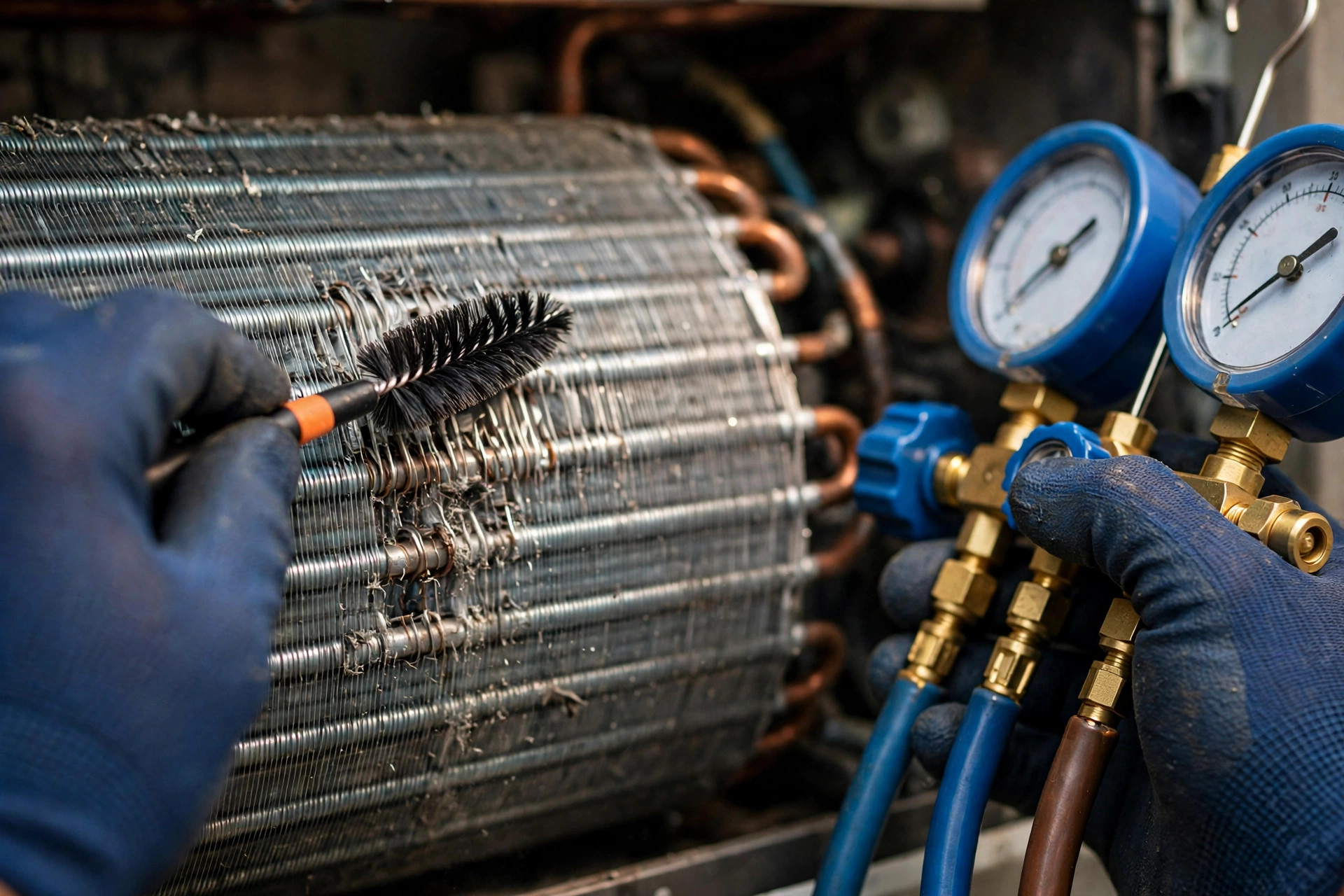
- Evaporator coil cleaning. The indoor coil absorbs heat from your home's air. When it is matted with dust, it cannot absorb heat properly, so the system runs longer and cools less. ENERGY STAR likewise lists cleaning evaporator and condenser coils as a core maintenance task.
- Condenser coil cleaning. The outdoor coil releases that heat outside. On Marco Island it also collects salt spray, sand, pollen, and lawn debris. A dirty condenser coil drives up head pressure, energy use, and compressor wear.
- Condensate drain clearing. In Florida humidity, the drain line carries gallons of water a day. Algae and sludge can clog it, causing overflow, water damage, and a float-switch shutdown that looks like a sudden breakdown.
- Blower and airflow check. The blower assembly, fan, and ductwork determine whether cooled air actually reaches every room. ENERGY STAR notes that airflow problems alone can cut system efficiency by up to 15 percent.
- Electrical and safety checks. Capacitor, contactor, wiring, and thermostat calibration are tested, because a weak capacitor or a pitted contactor is one of the most common causes of a no-cool call in coastal Florida.
If a "cleaning" visit does not open the indoor unit, inspect the coils, and clear the drain, you have paid for a rinse, not a service. Ask what was cleaned, and ask to see photos of dirty coils if the technician recommends a deeper clean.
What Refrigerant (Gas Filling) Actually Means
Refrigerant is the fluid that carries heat: it evaporates in the indoor evaporator coil, absorbing heat from your home, and condenses in the outdoor condenser coil, releasing that heat outside. Modern Marco Island systems typically use R-410A; older systems may still use R-22, and some very new systems use R-454B. The exact type and the factory charge weight are printed on your outdoor unit's rating plate, and a technician must match them — refrigerants are not interchangeable.
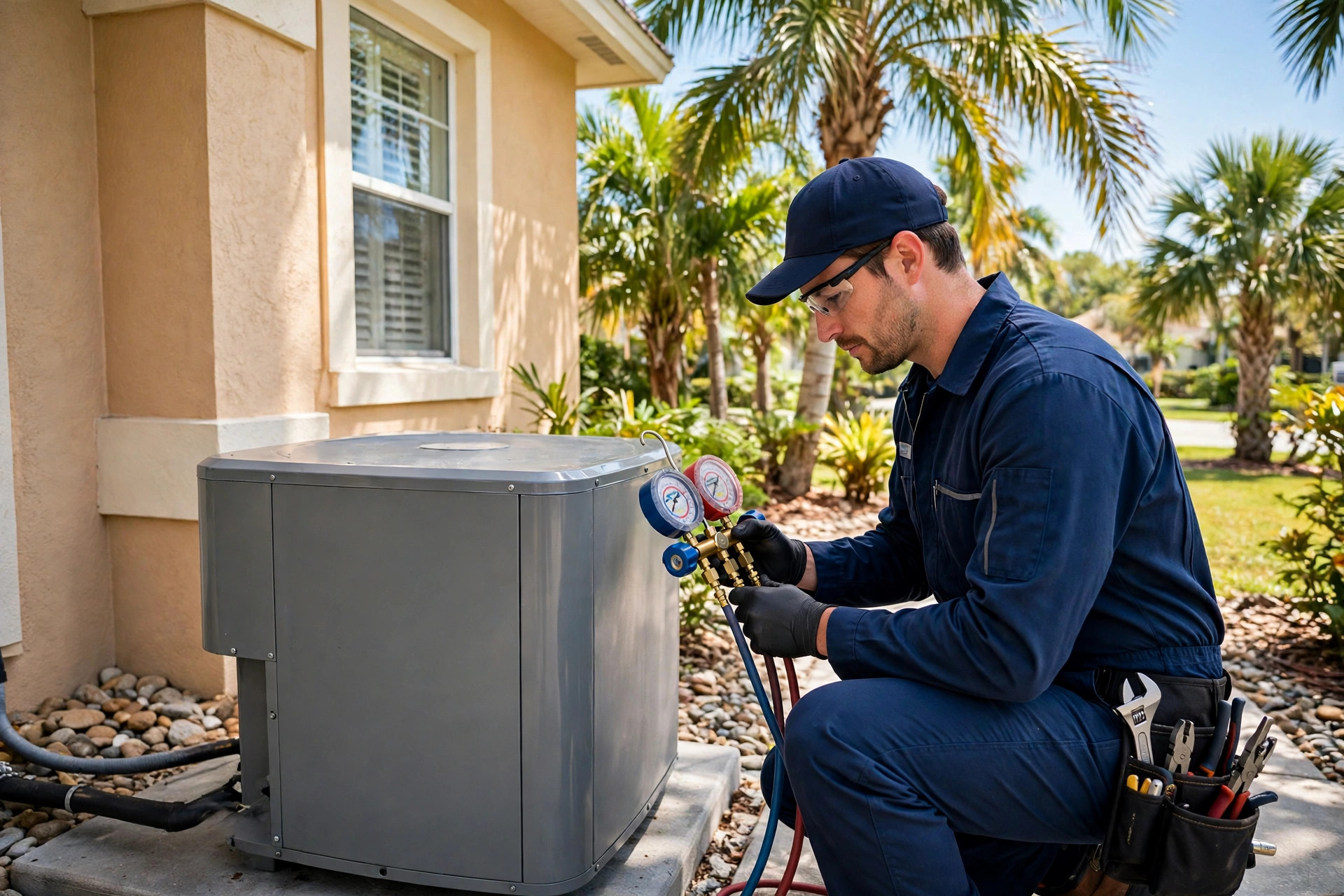
A proper refrigerant service is a measured procedure, not a guess. The technician connects manifold gauges, measures suction and liquid pressures and temperatures, and compares them against the manufacturer's target superheat or subcooling for the day's conditions. Only then can anyone honestly say the system is low, correctly charged, or overcharged. Too little refrigerant starves cooling and can freeze the coil; too much raises pressures, wastes energy, and can damage the compressor. Either way, the number on the gauge — not a feeling — decides.
The Big Myth: Your AC Does Not "Use Up" Refrigerant
This is the single most important thing to know before you pay for a top-up. A home air conditioner is a sealed system. It does not burn refrigerant, and it does not slowly consume it in normal use. As HomeGuide puts it, home air conditioners never need to be recharged unless there is a leak in the refrigerant system or after repairs that required the refrigerant to be removed.
That has a direct consequence: if your system is low, something leaked. Common leak points include valve cores, flare connections on ductless mini-splits, corroded coils, and rubbed-through copper lines — and salt air accelerates corrosion at every one of them. A top-up without a leak search is a temporary fix. The gas escapes again, the cooling fades again, and you pay again. A good technician will explain this, offer leak detection, and tell you honestly when a small leak repair makes sense and when an aging, corroded coil means a larger decision. If you need that conversation, our HVAC repair team can diagnose the real cause rather than just refilling and leaving.
Signs You May Need Cleaning or a Refrigerant Check
Dirty coils and low refrigerant share symptoms, which is why both should be checked together. Call for a visit if you notice:
- Warm or only slightly cool air from the vents, even though the system runs constantly
- The house never reaches the thermostat setting on a normal Marco Island afternoon
- Ice or frost on the indoor coil, the copper refrigerant lines, or the outdoor unit
- Hissing or bubbling sounds near the indoor or outdoor unit
- Water pooling near the indoor unit, or the system shutting off unexpectedly
- Electric bills climbing without a change in how you use the system
- Weak airflow from some or all vents
What a Proper Visit Looks Like, Step by Step
A well-run cleaning and refrigerant visit in a Marco Island home usually follows this order, and takes one to two hours for the cleaning and inspection alone:

- Interview and thermostat check. What symptoms have you noticed, and does the thermostat read accurately and cycle normally?
- Filter, airflow, and indoor inspection. Filter condition, blower operation, evaporator coil condition, and condensate drain flow.
- Outdoor inspection and coil cleaning. Condenser coil condition, clearance around the unit, fan operation, and electrical components including the capacitor and contactor.
- Pressure and temperature measurement. Gauges connected, superheat or subcooling calculated, and the result compared with the manufacturer's specification.
- Leak check if the charge is low. Electronic detection, bubble testing, or dye, depending on the suspected location — before any refrigerant is added.
- Refrigerant added only if needed, by weight or by measured charge. The amount added and the final readings should be written on your invoice.
- Final run test. Supply and return air temperatures, normal cycling, drain flow, and a clear explanation of anything that still needs attention.
What It Typically Costs
Prices vary by system size, refrigerant type, and how much gas is needed, so treat these as national ranges from published guides, not as a quote for your home. A standard single-visit tune-up runs roughly $90 to $200, with a national average around $150, according to one 2026 maintenance-cost guide — and that same guide stresses that a refrigerant recharge is not part of a standard tune-up, averaging about $300 as an add-on. Angi's Charlotte guide puts a typical recharge at $195 to $487, averaging $292, with refrigerant itself at roughly $12 to $78 per pound depending on type and system age.
HomeGuide gives a similar picture: roughly $100 to $320 for an R-410A refill and $180 to $600 for R-22, with a complete refill averaging $300 to $1,000, and up to $1,500 for large older R-22 units. Coil cleaning alone is often quoted at $75 to $700 depending on access and condition. R-22 costs far more per pound than R-410A because production ended years ago, and the total bill depends mostly on how many pounds are missing.
For an exact price on your system, call Marco Island AC Services at (239) 880-1889 with your unit's model and refrigerant type from the rating plate, and ask for an itemized quote that separates the cleaning visit, leak detection, and refrigerant by the pound. If a quote bundles everything into one vague "gas filling" price, ask what is inside it.
Marco Island Factors: Salt Air, Humidity, and Seasonal Homes
Marco Island is harder on air conditioning than almost anywhere else in Florida, and that changes how often cleaning matters. Salt air corrodes condenser coil fins, electrical connections, and fasteners faster than inland air, so outdoor coils need washing and inspection more often — not just once a year if your unit sits near the water or faces the prevailing breeze. Humidity keeps condensate drains working overtime, so a drain that clogs in a drier climate once in a decade can clog here every season. And seasonal homes add a trap of their own: a system left off for months can grow mold on a damp evaporator coil and drain pan, then blow that first musty blast through the house on the owners' return.
If you own a seasonal home, schedule cleaning before you arrive for the season, not after the first hot weekend — a pre-season visit is far cheaper than an emergency AC repair on a Saturday night in July. Regular AC maintenance is the simplest way to keep a coastal system reliable.
What to Ask Before You Book
Use these questions to separate a thorough technician from a quick top-up merchant:
- "Will you measure pressures and temperatures, and will you write the readings on the invoice?"
- "If the charge is low, will you look for the leak before adding refrigerant, and what does leak detection cost?"
- "What exactly does your cleaning include — both coils, the drain, the blower, and electrical testing?"
- "What refrigerant does my system use, and how much per pound will you charge for it?"
- "If the coil is leaking and corroded, at what point would you recommend replacement instead of another repair?"
When Cleaning or a Top-Up Is Not Enough
Sometimes the honest answer is that no amount of cleaning or gas will fix the problem. A compressor that is drawing high amps, a coil that has leaked twice, a system over 15 years old running R-22, or a unit that was never sized correctly for the home may all be better served by a planned upgrade than by repeated repairs. That is a decision to make with numbers in front of you — repair cost, refrigerant cost, remaining life, and the efficiency gain from a modern SEER2 system — not under pressure during a breakdown.
If your system is aging, an AC installation consultation can lay out those numbers without obligation. The same principles apply to ductless mini-splits and heat pumps: sealed refrigerant circuits, coils that need cleaning, and drains that need clearing.
The Bottom Line for Marco Island Homeowners
Book a real cleaning once a year at minimum — more often if you are near the water, run the system year-round, or own a seasonal home. Expect refrigerant to be checked, not automatically added, and expect a leak search whenever the charge is low. Keep the filter clean between visits, keep two feet of clearance around the outdoor unit, and never let anyone sell you an annual "gas top-up" as routine maintenance: a sealed system that needs gas every year has a leak, and the leak is the job.
If your AC is blowing warm, icing up, running all day without cooling, or leaving water where it should not, call Marco Island AC Services at (239) 880-1889. Our technicians will clean what needs cleaning, measure what needs measuring, and tell you plainly whether your system needs a top-up, a leak repair, or something else entirely — before you spend a dollar on gas.